Front matter
Front Matter
Declarations
This dissertation is the result of my own work and includes nothing which is the outcome of work done in collaboration except where specifically indicated in the text
This dissertation does not exceed the word limit as set out by the Degree Committee of the Faculty of Law.
The total word count is 15888
List of Tables
List of Figures
Chapter 1
Introduction
Few crimes capture the public imagination as vividly as tomb robbing. In China, it has inspired best-selling novels, films, and television dramas that picture the tomb raider as a lone adventurer who outwits ancient traps in search of buried treasure. The reality is far less romantic and far more troubling. Behind the fiction lies a persistent criminal industry that has disturbed more than two hundred thousand ancient tombs in recent decades, stripping the country of relics that can never be recovered and erasing the archaeological record that gives those relics their meaning (Lanet al., 2024). So pervasive is the practice that experts estimate 80 percent of China’s tombs have already been plundered, and officials concede that the problem has become nearly impossible to eliminate (Qin, 2017). One provincial heritage official captured the scale of the challenge with a telling comparison: “It’s just like illicit drugs in the United States. Even though the government bans tomb robbing, there are still many people who do it” (ibid.). The analogy is insightful. Similar to the illicit drug trade, tomb looting is a demand-driven supply chain so widespread and so diffuse that enforcement can disrupt it but never extinguish it. Because looted property and cultural relics belong to the Chinese state, the law treats this activity not as ordinary theft but as an offence against the nation itself, punishable by sentences that reach up to life imprisonment and, in the most extreme case on record, death (Agence France-Presse, 2017).
Tomb robbing is also one of China’s oldest crimes (Wang, 2026). Across the centuries, graves were opened for many reasons, from profit and revenge to ritual meaning and superstition, but the looting of today has narrowed almost entirely to a single motive, money (ibid.). The profit of tomb robbing is derived from the Chinese culture that the rich would bury their wealth and collections with them. Therefore, inside the tomb there will be gold, silver, and bronze, as well as artwork and handicrafts that contain cultural values. From the current perspective, tomb looting in China is a form of cultural heritage crime (INTERPOL, 2026). As a cultural heritage crime, tomb looting is a common crime that happens around the globe, including Turkey, Egypt, and Cambodia (see Mackenzie and Davis, 2014). In addition, tomb robbing is an essential part of illicit trafficking in cultural property, as it steals artifacts from archaeological sites. In China, the harshness of modern response is in part an inheritance from a long past in which every dynasty treated the violation of a grave as a serious wrong, and from a culture that has always prized its antiquities and honoured its ancestors. That long memory helps explain why the contemporary state still reaches for some of its heaviest penalties when a tomb is disturbed. Understanding tomb robbing therefore means understanding both an ancient cultural anxiety and a very modern criminal economy.
Despite the seriousness of the crime, surprisingly little is known about the people who commit it or about how their operations are actually put together. Most of what reaches the public comes from sensational news reports or from fiction, and neither explains how a real looting group works. Scholarly attention has been limited as well. The most systematic study to date, by Lanet al. (2024), draws on 2525 pieces of court records to describe looters across the whole country as predominantly undereducated, profit-driven farmers and unemployed middle-aged men who work in groups of four to nine. This national portrait is valuable, yet it views the crime from a great height. It does not open up a single group to show who works with whom, who gives the orders, and why the group holds together. Knowing that looters tend to be poor rural men tells us who they are, but not how their work is organised, how a job moves from the digging of a grave to the sale of a relic, or what keeps such a loose collection of people working as a unit. That missing close view is the gap this thesis sets out to fill.
This thesis is guided by a single overarching question: to what extent, and in what form, does tomb looting in China operate as organised crime? The question has two parts that the study keeps deliberately separate. The first is whether looting qualifies as organised crime at all, a question less settled than it first appears. In the most systematic study of antiquities looting to date, Balcells (2023) concludes that Italy’s tomb raiders are not organised criminals but ordinary people who need only a little organisation to operate. Whether the same is true of China cannot be assumed; it has to be demonstrated.
The second part asks what kind of organised crime looting is: a tightly run firm, in which the same people cooperate under direction over time, or a looser market, in which independent operators are recruited job by job and then go their separate ways (Coase, 1937; Campana, 2016). A third question runs across both. The thesis compares two real looting groups of very different size and reach and asks why each takes the organisational shape it does, and what their contrast reveals about how a looting enterprise grows and changes as it expands.
To answer these questions, the thesis reads each group twice: once from inside the offender network, to see how the work is structured and coordinated, and once from the perspective of the sentencing state, to see how the courts treat those involved. This dual reading matters because the label of organised crime carries real weight. It shapes how seriously the state responds, how offenders are punished, and how Chinese looting can be compared with similar crimes elsewhere in the world, and for that reason it deserves to be established on evidence rather than asserted.
To do so, this thesis adopts a positivist, quantitative, and deductive approach, and applies it to evidence that has been used too rarely. The Supreme People’s Court of China publishes millions of judgments on a public archive known as China Judgment Online. From this archive, the study selects two unusually detailed cases that together involve 50 offenders and 16 separate looting events. The first, referred to throughout as Group A, is a mobile team of 33 people who travelled far from home and hid their activity behind cover businesses. The second Group B is a smaller operation of 17 people rooted in one organizer’s home community. The two cases are compared side by side so that the differences between them become visible.
The analysis rests on a simple but powerful idea borrowed from economics. Coase (1937) observed that work can be coordinated in two very different ways: inside a firm, where the same people work together under direction over a long period, or through a market, where independent people are hired for a single job and then go their separate ways. Campana (2016) brought this model into criminology to explain how a human trafficking network was organised. Following his framework, each case in this thesis is rebuilt as a network of who took part in which event. The study then measures the shape of these networks, tests what draws particular offenders together using a statistical method designed for network data, and models what determines the prison sentences that convicted members received.
This approach produces three main findings. First, the two groups are best understood not as two separate kinds of organisation but as two stages of a single growing enterprise. Both share the familiar profile of rural property crime, with men making up more than ninety-five per cent of offenders, an average age of around forty-two, and most members educated only to middle school level. The smaller group behaves like a local operation built around one central figure, while the larger group has matured into a mobile, market-facing business. The contrast between them shows what happens when a village looting team gathers resources, recruits beyond the village, and grows outward.
Second, both networks behave like illicit supply chains rather than like gangs or family clans. Most offenders take part in only a few events, and repeated cooperation falls away sharply, which is the signature of a market-style operation rather than a tight and permanent firm. What brings two offenders together is not a shared criminal past or time spent together in prison, but shared village origin, looting skill, and membership of the same migrant labour networks. The digging itself is densely coordinated, the selling end is handled by brokers and buyers who work in isolation from one another, and a single organiser links the two ends together. Coordination in China, in other words, runs on Guanxi, kinship and rural-to-urban migration, where Campana found ethnicity and the crossing of borders.
Third, the Chinese courts already treat these crimes with the severity reserved for serious organised crime. The strongest predictor of a long sentence is the number of stages of the operation in which an offender took part, which rewards exactly the all-round involvement that marks a central player. A prior conviction adds roughly two to three years for those who perform the physical work of looting, yet this recidivism premium vanishes for brokers. The court records suggest the reason. Brokers sit at the visible selling end of the chain, so they often learn of the arrests through public news coverage and turn themselves in, which earns them the leniency that Chinese law grants for voluntary surrender.
Drawing these findings together, the thesis argues that contemporary tomb looting in China is a complex criminal enterprise that operates as an illicit supply chain, and that the state itself recognises this through the way it punishes offenders. The contribution is twofold. For theory, it extends Campana’s firm and market framework beyond the transnational, ethnically organised trafficking for which it was designed, and shows that the framework also explains a homegrown domestic crime once ethnicity is replaced by the local social ties that bind rural China. For method and policy, it demonstrates that publicly available court documents contain underestimated academic value and shows that seizing the sole key offender could effectively collapse the entire criminal network.
The thesis is organised into six chapters. This first chapter introduced the problem, the research questions, and the main findings. Chapter Two reviews the existing literature through three connected stories: what tomb robbing in China is and why the state treats it so seriously, how scholars have debated whether such activity counts as organised crime, and where current research stops, and this study begins. Chapter Three explains the methodology, including the choice of a positivist design, the selection of the two cases, the coding of court records into networks, and the statistical tools used to analyse structure and sentencing. Chapter Four presents the findings in three parts: profiling the two groups, mapping their network structure and coordination, and examining their sentencing outcomes. Chapter Five discusses what these results mean, connecting them back to the theoretical debates, drawing out the implications for how looting is policed, and acknowledging the limits of the study. Chapter Six finally concludes the thesis and points toward future research.
Chapter 2
Literature Review
This chapter reviews the knowledge of tomb robbing and the limits of the current knowledge. Thus, the findings of this paper could be well situated on an empirical basis and the academic debates. Tomb robbing in China is an old crime with a modern shape, and most readers outside China, and indeed many inside it, meet it first through dramatic news stories rather than careful study. The aim here is to move from that popular image toward a research-based understanding, and to do so in a way that a reader who is new to the subject can follow.
The review is built around three connected sections. The first section conceptualises tomb robbing offence in China. It traces the history of the crime, explains why the Chinese state treats the theft of buried relics so severely, and shows why this national context matters for everything that follows. Then the second section discusses Chinese tomb looting offence in the lens of organised crime. It introduces the long debate over what organised crime is, and it sets out the economic way of thinking, drawn from studies of trafficking in other countries, that this thesis uses to make sense of how looting groups are put together. The third section turns to the research itself. It reviews the best existing work on Chinese looting and on Chinese sentencing, and it shows that, for all their strengths, these studies leave three specific questions unanswered.
Together, these chapters give a newcomer enough background to understand the analysis, and they explain the potential contribution of the analysis. By the end of the chapter, the reader should see not only what tomb looting is and how to think about it, but also the precise gap in knowledge that the rest of this project aims to fill.
Conceptualising Tomb Robbing in China
China’s long history and its tradition of placing valuable goods in graves have made the robbing of ancient tombs a problem for as long as those tombs have existed. The activity is not new, but it has never gone away. Lanet al. (2024) note that looting was especially fierce during the 1980s and 1990s, when organised chains for finding, digging, stealing, moving, and selling relics took shape across the country. Even after decades of stronger law enforcement, more than two hundred thousand ancient tombs are estimated to have been disturbed. The crime that this thesis studies is therefore both ancient in its roots and very much alive in the present.
Although crime itself is constant, its motives have not always been the same. In his historical and cultural study of grave robbing, Wang (2026) shows that opening a tomb has served several different purposes across Chinese history. The most familiar is material profit, the wish to seize the valuable goods buried with the dead. Yet tombs were also disturbed out of revenge, as a way of punishing an enemy or a fallen ruler by violating the resting place of his family, and as a symbolic act that carried political or ritual meaning. In some cases, the motive was darker, rooted in personal compulsion or perversion, and in others it grew out of feudal superstition about the dead and their powers. This long list of motives matters for one main reason. It shows that tomb robbing in China today, which is overwhelmingly driven by profit, is the narrowing of a much older and broader practice down to a single commercial purpose.
Two further historical threads help explain why the modern Chinese state reacts so strongly. The first is that every dynasty treated the robbing of graves as a serious crime; therefore, the severity of today’s law is largely the continuation of a very old habit rather than a recent invention. The second is cultural. China has long valued its antiquities and has built a deep respect for ancestors and for age into its traditions (Wang, 2026: 729). This reverence for the old is itself a form of historical inertia, carried forward from one era to the next. When a contemporary court punishes a looter harshly, it is therefore acting within a tradition that has regarded the violation of the dead and the theft of the nation’s relics, as profound wrong for many centuries.
In Chinese law, the offence has a precise name. Article 328 of the Criminal Law defines the crime of excavating sites of ancient culture and ancient tombs as the unlawful digging of relics that carry historical, artistic, or scientific value (Lanet al., 2024). Two features of this definition deserve attention from readers who rarely read Chinese criminal law. The first is that the law protects the relic because of its cultural worth, not simply its market price. The second is that the relics are treated as belonging to the state. In China, the looted property and the cultural relics are state-owned, which means that an act of looting is understood as an offence against the nation itself rather than against a private owner.
This idea of harm to the nation explains why China punishes looting far more heavily than some other countries do. It is worth noticing that antiquities looting is not considered a serious crime in Italy. The difference is that the Chinese state-owned system decides that such looting is against the state, because the looted property and cultural relics are state-owned. In addition, between the nineteenth and twentieth centuries, colonial history produced a monumental loss of Chinese cultural objects (see Chen, 2022). Therefore, in contemporary China, private antiquities looting is considered a serious offence that disrupts social order and damages Chinese history, heritage, and memory. Chinese tomb robbing also tends to target the tombs of ancient imperial family members, which often contain highly valuable items. Tomb robbing in China is therefore a grave offence, and there is even a record of the death penalty being handed to the leader of a very large grave robbing network .
The contrast with Italy is useful because it shows that the seriousness of looting is not a fixed fact of nature but a choice that each society makes. Balcells (2023) describes how Italy, despite being one of the richest source countries for looted antiquities in the world, does not treat its tomb raiders, known locally as tombaroli, as a major criminal threat. The same physical act, digging up an ancient grave for profit, is read very differently depending on who is thought to own the past. Where Italy sees a problem of heritage protection, China sees an attack on a state asset and on the nation’s cultural memory. This difference in framing will matter again in the next section, because how a society defines the harm shapes how willing it is to call the offenders organised criminals.
To measure how serious the offence is in formal terms, it helps to use an international criteria. The United Nations Convention against Transnational Organized Crime defines a serious crime as one that carries a maximum penalty of at least four years in prison (UNCTOC, 2004: 5). Chinese law sets the maximum penalty for tomb looting well above this line, reaching life imprisonment; thus, the offence clears the threshold with room to spare. By any common measure, this is a serious crime.
Knowing that the crime is old, widespread, and treated with great severity still leaves an obvious question unanswered. A successful robbery is rarely the work of one person. It calls for the skill to locate a hidden tomb, the nerve and equipment to dig it out, and the contacts to move and sell what is found. That practical need for cooperation is the bridge to the second section, which asks whether such cooperation amounts to organised crime.
Conceptualising Tomb Robbing as Organised Crime
If the first section establishes that tomb robbing is treated as a serious crime, the second examines whether this is an organised crime. Labelling tomb robbing as organised crime is intuitive, but that label is more difficult to pin down than it appears. Defining Organised Crime Groups (OCGs) is problematic, as well as the OCGs themselves (Houriganet al., 2018). In addition, the definitions of OCGs are rooted in different societal realities; therefore, they could vary in other countries (Albanese, 2000: 410-14).
However, there are some critical overlaps. The European Union and Europol describe organised crime through a list of eleven characteristics, and they require a group to show at least six of them before they treat it as organised crime (Levi, 2002: 882; Newburn, 2017: 432). Four of these characteristics are mandatory: the group must involve more than two people, it must work together over a period of time, it must commit serious criminal offences, and it must act for profit or power. A group must also show at least two more characteristics from the list, such as a clear division of tasks, internal discipline, operation across borders, the use of violence, or the laundering of money. The United Nations adopted a similar but more abstract definition (Levi, 2002: 884); however, the overlap in profit-driven is critical. Apart from this overlapping definition, Campbell (2016: 556-7) also highlighted that generating wealth and power is the central motivating force of organised crime. In the Chinese prosecution practice, the definition of organised crime largely aligns with the above definitions (Liu, 2009: 98). However, Chinese organised crime showed some unique characteristics (see Wang, 2013).
Those local features matter for placing tomb raiders correctly. Organised crime groups in contemporary China fall into two broad categories (Trevaskes, 2010: 143). The largely unsophisticated groups and the loosely organised gangs are categorised as “dark forces” (e’shili). In contrast, the state labels more mature criminal syndicates as organisations of a gangland or mafia nature (heishehui xingzhi zuzhi). These mature, organised crime groups are characterised by connections and protection from government officials, legal business fronts, and control over a particular part of society through criminal activities, which is impossible for smaller and less mature criminal groups (Wang, 2013: 7). The Chinese tomb-raiders discussed in this study generally fall into the former category, because a successful tomb robbery require knowledge and expertise in finding the tomb, sophisticated and risky unearthing that involves metal detectors and night vision devices, and efficiently empty and transport the contents, which almost impossible to complete alone. Therefore, tomb robbery itself requires certain levels of organisation; however, very few tomb robbery groups evolved into criminal syndicates, because larger groups create management issues and the risk of being detected is multiplied (see Balcells, 2023: 8).
These definitions capture only one of the two ways scholars think about organised crime, and the difference matters for how we classify looting. The first tradition follows Gambetta (1993) and Varese (2001). It treats organised crime as a form of private governance, in which the mafia supplies protection, settles disputes, and controls territories, much as a state does. The second tradition runs from Reuter (1983) to Campana (2016). It treats organised crime as an illegal enterprise, in which criminals coordinate to supply banned goods and services, such as drugs, trafficked people, or looted antiquities, and divide the labour between them. This difference matters. Under the governance view, tomb looting does not count as organised crime, because looters do not govern territory or sell protection. Yet the same logic also excludes drug trafficking and human trafficking, because they too supply goods rather than rule. This gap is therefore not a special weakness of looting. Every crime that supplies an illegal market shares this feature. This thesis adopts the enterprise view, and so it treats organised crime as a question of coordination rather than organisation. The question is no longer whether looters form a mafia. It is how looters coordinate the supply of looted antiquities. Looting must still solve the problem that governance solves for the mafia. Partners in an illegal trade cannot sign contracts or sue each other, so they need another way to build trust. The mafia uses territorial control, and Campana’s (2016) traffickers use kinship and ritual. Chinese looting networks, as later chapters show, use Guanxi and shared local origin to build that trust.
Labelling an offence as organised crime, however, does not explain how it is organised, and thus calls for an additional approach to this inquiry. Economists have long explored different models of organisations. Coase (1937) observed that some activity is coordinated inside a firm, where a manager directs the same workers over time, while other activity is coordinated through the market, where independent people are hired for a single job and then go their separate ways. The choice between the two depends on cost. Campana (2016) brought this model into the study of crime in his work on a Nigerian human trafficking network. He showed that criminal cooperation also carries costs, especially the cost of monitoring partners who cannot be trusted and cannot be taken to court if they cheat. In his case, the trafficking ring did not run along family or ethnic lines, as is commonly assumed. Instead, it relied on a clear division of labour and on offenders who acted as independent contractors, behaving more like a market than a firm. Whether a criminal operation looks more like a firm or more like a market thus becomes a question that can be tested with evidence, and that question sits at the heart of this thesis.
The market image fits looting especially well because looting is only the first link in a longer chain. Mackenzie and Davis (2014), in the first close study of a statue trafficking network, traced how looted objects pass from the ground to the international buyer through a small number of stages: the local digger, the regional broker, the cross-border dealer and the final collector. They drew attention to one figure in particular, a middleman who “faces both ways,” showing a criminal face to the looters below and a respectable face to the legitimate art market above. This person is the gateway that turns stolen relics into saleable goods. Their study confirmed that organised crime is indeed involved in looting, and that the distance from a robbed tomb to a public sale can be surprisingly short.
Not every scholar agrees that looters are organised criminals. Studying tomb raiders in Italy, Balcells (2023) concluded that looting there is not a problem of organised crime. His verdict, however, turns on a single point. He checked Italian looters against the criteria in the UNCTOC (2004) definition and found that they met almost all of them: they work in structured groups of three or more, they operate over long periods, and they act for profit. They failed only one test, the requirement that the crime be serious, because Italian law punishes looting with at most one year in prison. This is exactly the test that Chinese looting passes. As the previous section showed, Chinese law allows sentences of up to life imprisonment, so the one criterion that excludes the Italian tombaroli is the criterion that the Chinese case clears most easily. The same act, digging up an ancient tomb for profit, therefore counts as organised crime in one country but not the other, and the difference lies chiefly in how each state punishes it.
Balcells matters here not as an obstacle but as a foil. By showing that looting is not automatically organised crime, and that the answer depends on the national setting, he turns the Chinese case into a real question rather than an assumption. Using Natarajan and Belanger’s (1998) typology, he also placed Italian looters at the loosest end of organisation, among freelancers and family teams. This thesis takes his distinction between an organised crime group and a crime that merely needs coordination seriously, but it tests the Chinese case with a sharper tool. Rather than sorting looters into fixed types, it asks where they sit between a tightly run firm and a loose market, and whether they amount to genuine organised crime or only to a coordinated activity of convenience. The tools for that test already exist, but researchers have so far used them on other crimes and other countries. The next section shows where this work begins.
Existing Research and the Gap
The first two sections explained what tomb robbing is and how this research approaches it as an organised crime concern. The third asks what researchers have actually managed to find out, and just as importantly, where their work stops. Three bodies of research are most relevant, and each one, for all its value, leaves a specific question open. Those open questions are the reasons this thesis exists.
The most important starting point is the study by Lanet al. (2024), which offers the most systematic picture of tomb robbing in China to date. Their research rests on 2,525 nationwide court records, from which they built a large database of Chinese grave robbery. Their analysis spans the years 2001 to 2021 and they report that groups of four to nine people are by far the most common, accounting for 80.82 per cent of cases, while fewer than 0.5 per cent of robberies are carried out by only one or two people (Lanet al., 2024: 1862). They also show that the offenders are predominantly under-educated farmers or unemployed middle-aged men, and that profit is the essential motive for their involvement, which fits the features of organised crime described in the second section (ibid.: 1857, 1864). They further divide looting into professional and occasional types, and they break each operation into four stages: forming a team, planning, carrying out the dig, and escaping. This is a rich and valuable map of the crime across the whole country. Yet it remains a map drawn from a great height. Because it pools thousands of cases to describe national patterns, it does not reconstruct the inner structure of any single group: who worked with whom, how often, and who sat at the centre. The first gap is therefore the absence of a close, network-level study of how an individual looting group is actually wired together.
The tools for such a close study already exist, but they have been built and tested elsewhere. Campana (2016) developed the firm versus market test described in the previous story, and Mackenzie and Davis (2014) mapped the supply chain of a looting network in fine detail. Both, however, examined trade that crosses borders and, in the wider trafficking literature, is often assumed to run along ethnic or family ties. Campana’s network operated between Nigeria and Europe, while Mackenzie and Davis followed statues out of Cambodia and into Thailand and the wider Western market. No study has yet asked whether the same economic logic holds for a domestic offence that takes place largely within one country’s borders, among offenders drawn from the same rural communities. The second gap is thus the question of whether Campana’s framework, so useful for transnational trafficking, also explains the shape of a domestic Chinese crime.
This domestic setting does more than move Campana’s question to a new country. It also brings into view a feature that the cross-border cases could not show, namely how far offenders travel to commit their crime. Environmental criminology has long studied this question. Brantingham and Brantingham (1978) argued that offenders look for targets inside the area they already know, and a large body of journey-to-crime research confirms that most offenders do not travel far from home (Townsleyet al., 2016). This research draws a basic contrast between two patterns. Marauders offend close to where they live, while commuters travel out to a separate area to offend (Brantingham and Brantingham, 1978; Hamm, 2023). Crime, on this view, does not spread at random. It reflects the choices offenders make about familiar space, known opportunities, and likely reward (Johnson and Summers, 2015).
This spatial logic should apply to looting as well, and Lanet al. (2024) gestured towards it when they separated theft within a city from theft across cities and mapped where each pattern clusters. They did not, however, connect these patterns to how a group is built. The connection matters, because a group’s spatial reach and its structure are likely to shape each other. A small local group cannot travel far, since its limited reach and resources tie it to its home ground, so it behaves like a marauder. A larger group can recruit looting experts, fund longer trips, and work across cities, so it behaves like a commuter and tends to mix locals with outsiders. No study has yet applied this spatial frame to Chinese looting networks, so we do not know how a group’s local or mobile character shapes who joins it and how its members coordinate. This gap is the reason the present study compares two contrasting groups, one rooted close to home and one that travels to work, and the next chapter explains that choice in full.
The third body of research concerns not how looters organise but how courts judge them. A growing field of Chinese criminology uses the very court records that this thesis relies on to study sentencing in a rigorous way. Tang and Cai (2021) analysed sentencing documents for drug smuggling by body packing, combining network analysis with statistical models to show that heavier sentences follow larger drug quantities and repeat offending, while special groups such as pregnant women, the disabled and minors receive more lenient treatment. Xin and Cai (2020) used nearly 142,000 sentencing records for traffic offences to show that offenders who pay compensation to their victims are more likely to receive lighter, probation-based outcomes. These studies prove that court records can support careful analysis of how legal factors, such as recidivism and voluntary surrender, and extra-legal factors, such as wealth, shape the punishments Chinese judges hand down. Chinese law builds several of these factors directly into sentencing, treating prior offending as an aggravating circumstance and voluntary surrender as grounds for leniency. In existing literature, very few researchers analysed the sentencing of organised crime groups (Albanese, 2021; Baradel, 2021). Thus, this thesis seeks to shed light on this underdeveloped area in organised crime studies and links this research topic to broader criminological theories such as power and gender.
These three gaps point in the same direction. There is a national portrait of looters but no close view of a single group. A proven theory of criminal organisation exists, but no test of it on a different context. In addition, there is an established method for studying Chinese sentencing, but no application of it to this offence. Each gap marks something worth knowing that no one has yet established. By reconstructing the networks of real looting groups, testing them against Campana’s framework, and modelling the sentences their members received, this thesis sets out to close all three. The next chapter explains how.
Summary
This chapter has worked through three connected stories so that the analysis to come has a clear foundation. The first section showed that tomb robbing in China is an ancient and persistent crime that the state treats with exceptional perceived severity, because looted relics belong to the nation and stand for its history and memory. It also showed that the motives behind looting have narrowed over the centuries from a wide mix of profit, revenge, ritual, and superstition down to profit alone, and that both the harshness of the law and the reverence for antiquity behind it are inherited from a long past. Comparison with Italy made clear that this severity is a social choice rather than a natural fact, and that choice shapes how readily the offenders are seen as criminals worth pursuing.
The second section turned from the crime to its classification. It showed that organised crime is difficult to define, but that most definitions agree on cooperation, duration, seriousness, and profit, and that Chinese law and practice fit this pattern while keeping features of their own. It then introduced the economic way of thinking, running from Coase to Campana, that treats criminal cooperation as a choice between a firm and a market, and it set the supply chain model of Mackenzie and Davis alongside the warning from Balcells that needing organisation is not the same as being organised crime.
The third section reviewed the best available research and found three clear gaps. Lan and colleagues describe looters across the whole country but never reconstruct a single group from the inside. Campana and others built a powerful framework, but tested it only on transnational trafficking, and no one asked how a looting group’s local or mobile character shapes the way the group is built. Chinese sentencing scholars analyse court records with great care but have never turned that lens on looting. These gaps are the reason for this thesis. It studies the inner structure of real Chinese looting groups, tests whether they behave more like firms or more like markets, and examines what drives the sentences their members receive. The chapter that follows sets out the data and methods used to do so.
Chapter 3
Methods
This chapter sets out the methodological framework that supports the analysis presented in this thesis. It first explains the research philosophy and design, restates the research question and hypotheses, and justifies the use of Chinese court judgments as the primary data source. It then describes how two tomb robbing networks were identified, how unstructured legal texts were turned into structured actor and event data, and how the resulting data were analysed. The five analytical procedures applied in this study are co-participation analysis, social network analysis, stage density analysis, QAP regression, and sentencing regression. Each procedure is described in plain terms so that the link between the research questions and the empirical work in Chapter 4 can be followed without prior expertise in network methods.
Research Philosophy and Design
This study takes a positivist, quantitative, and deductive approach: it treats the structure of a criminal network as a social fact that can be measured through replicable procedures rather than co-constructed with participants (Park, Konge and Artino, 2020; Babbie, 2021). The approach is well established in network research on organised crime (Morselli, 2009; Campana, 2016; Tang and Cai, 2021). Theoretical propositions, in particular Campana’s (2016) application of Coasian firm theory to criminal networks, are turned into measurable variables and tested against Chinese data, asking whether a framework built for cross-border trafficking travels to a domestic setting shaped by kinship, Guanxi, and rural-to-urban migration.
The design is explicitly comparative. It examines two prosecuted cases side by side, Group A and Group B, which committed the same offence in the same legal context but were organised differently. This suits a most similar systems design, holding national context and offence type constant while organisational form varies (Raab and Milward, 2003), so that structure becomes the explanation of interest.
This positivist choice invites an obvious objection: an interpretivist would want to talk to looters and reconstruct how they see their work. That criticism has force, but access defeats it at scale. Tomb looting is a hidden and serious crime whose offenders are scattered, imprisoned, or in hiding, so interviews and ethnography, where possible at all, capture a few voices rather than the shape of a network. Court records, by contrast, give consistent accounts of many offenders and events at once and support systematic, replicable analysis. The design does not deny that looting carries meaning; for this question it chooses the source that can be worked at scale, while accepting the limits of court records that a later section sets out.
Research Question and Hypotheses
This study addresses one overarching question. To what extent, and in what form, does tomb looting in China operate as organised crime? The question has two parts. The first asks whether looting counts as organised crime at all. The second asks, if it does, what kind it is: a tightly run firm, in which the same people cooperate in a direction over time, or a loose market, in which independent operators join a single job and then leave (Coase, 1937; Campana, 2016). A third question runs across both and drives the comparison. Why do the two groups take the organisational shapes that they do?
To answer these questions, the study reads each group from two angles. It looks first from inside the offender network, to see how the members structure and coordinate their work, and then from the position of the sentencing court, to see how the state punishes them. The hypotheses follow this order. The first pair concerns structure and coordination, and the second pair concerns punishment.
Following Coase (1937) and Campana (2016), a market mode relies on independent contractors who join a single job and then go their separate ways, while a firm mode relies on a stable group who work together under direction over time. The first two hypotheses test where the two cases sit along this firm-to-market continuum.
The study tests four hypotheses, set out below in these two pairs.
- H1. The two looting networks work as illicit supply chains rather than as cohesive gangs or family clans. Most offenders take part in only a few events, repeated cooperation falls away sharply, a single organiser joins the digging end to the selling end, and the looting stage shows far denser coordination than the market stage.
- H2. Coordination between offenders rests on purposeful, locally rooted ties, namely shared village origin, looting skill, and migrant labour networks, rather than on a shared criminal record or prison acquaintance.
- H3. The court punishes the breadth of an offender’s involvement more than personal background. The number of operational stages in which an offender takes part predicts sentence length more strongly than age, education, or type of lawyer.
- H4. The weight that a prior conviction adds depends on an offender’s position in the supply chain. It lengthens the sentences of those who do the physical work of looting, yet it fades, or even reverses, for brokers at the selling end, who use their distance from the operation to surrender voluntarily and earn leniency.
Read together, the two pairs support a single claim that the analysis sets out to test. Through both its structure and its punishment, contemporary Chinese tomb looting works as organised crime in Campana’s (2016) sense, and not merely as a crime that needs some coordination in the sense of Balcells (2023). Table 3.1 maps each hypothesis to the procedure that tests it.
| Hypothesis | Operationalisation | Procedure |
|---|---|---|
| H1 | Illicit supply-chain shape: sharp decay in repeat co-participation, a single organiser linking the digging and selling ends, and a looting stage denser than the market stage | Co-participation decay; stage-density analysis |
| H2 | Coordination driven by shared village origin, looting skill, and migrant labour ties, not by criminal record or prison acquaintance | QAP regression |
| H3 | Breadth of involvement, measured by the number of operational stages, predicts sentence length more than personal background | Sentencing regression with a rank-correlation check |
| H4 | The recidivism premium depends on supply-chain position, rising for looting-stage actors and fading for brokers | Role-stratified sentencing analysis |
Data Source: China Judgment Online
Empirical data were collected from China Judgment Online (CJO), the official public repository managed by the Supreme People’s Court of China. Since 2013, the Supreme People’s Court has required all levels of the People's Court to upload sentencing documents to CJO, with the exception of cases involving state secrets, personal privacy, juvenile offenders, disputes resolved through mediation, and other matters considered inappropriate for public disclosure (Supreme People’s Court, 2013). As of 2025, the platform hosts more than 153 million case files covering courts in all 31 Chinese provinces, which makes it the most nationally comprehensive source of criminal sentencing data in China.
The coverage of CJO has been examined in recent methodological work. Lin, Xia and Cai (2024) estimated upload rates of between 52 and 80 per cent across four surveyed cities, a figure substantially higher than earlier pessimistic assessments. This suggests that CJO captures a broadly representative slice of the criminal caseload rather than a curated subset. Mei (2024a) confirms the platform’s reliability for criminological research. Because the platform is managed by the judiciary itself, it is considerably more dependable than media reports, police press releases, or qualitative interview data, all of which are subject to well documented selection and recall biases (Wright, Klee and Reid, 1998; Campana, 2016).
CJO has supported a growing body of quantitative criminology in China. Cai and colleagues have studied cybercrimes (Caiet al., 2018), human trafficking (Xiaet al., 2019; Mei, 2024b), criminal traffic offences (Xin and Cai, 2020), drug trafficking through body packing (Tang and Cai, 2021), violent crime against health professionals (Xiaoet al., 2022), and the illicit organ trade (Mei, 2024a). Among these, Tang and Cai (2021) is especially relevant to the present study, because their combination of network analysis and sentencing regression applied to Chinese court documents closely parallels the dual method design used here. Together, this body of scholarship validates CJO as a legitimate and productive data source for empirical criminological research in the Chinese context.
Reliability of this kind, however, is not the same as neutrality, and the records still need careful critical appraisal. A court judgment is not a transparent window onto the reality of looting. It is an official document that the state produces in order to render the crime legible and punishable. Legal categories, prosecutorial priorities, rules of evidence, and institutional incentives shape what each judgment records, so it shows what the justice system treats as relevant and can prove, not the full social reality of an offence. Several consequences follow for this study. The networks here are prosecuted networks. They contain only the actors, ties, and events that the court established, so offenders who escaped, died, or faced a separate trial fall outside them. Roles and relationships appear only where the evidence supported a finding. The records also probably under-represent cases that touch on official corruption, since the Supreme People's Court lets courts withhold sensitive material. This thesis therefore treats its court records not as neutral descriptions of tomb looting, but as authoritative reconstructions through which the state makes the crime visible and governable, and it reads its results with that framing in mind. The limitations section returns to what this means for the findings.
Case Identification and Inclusion Criteria
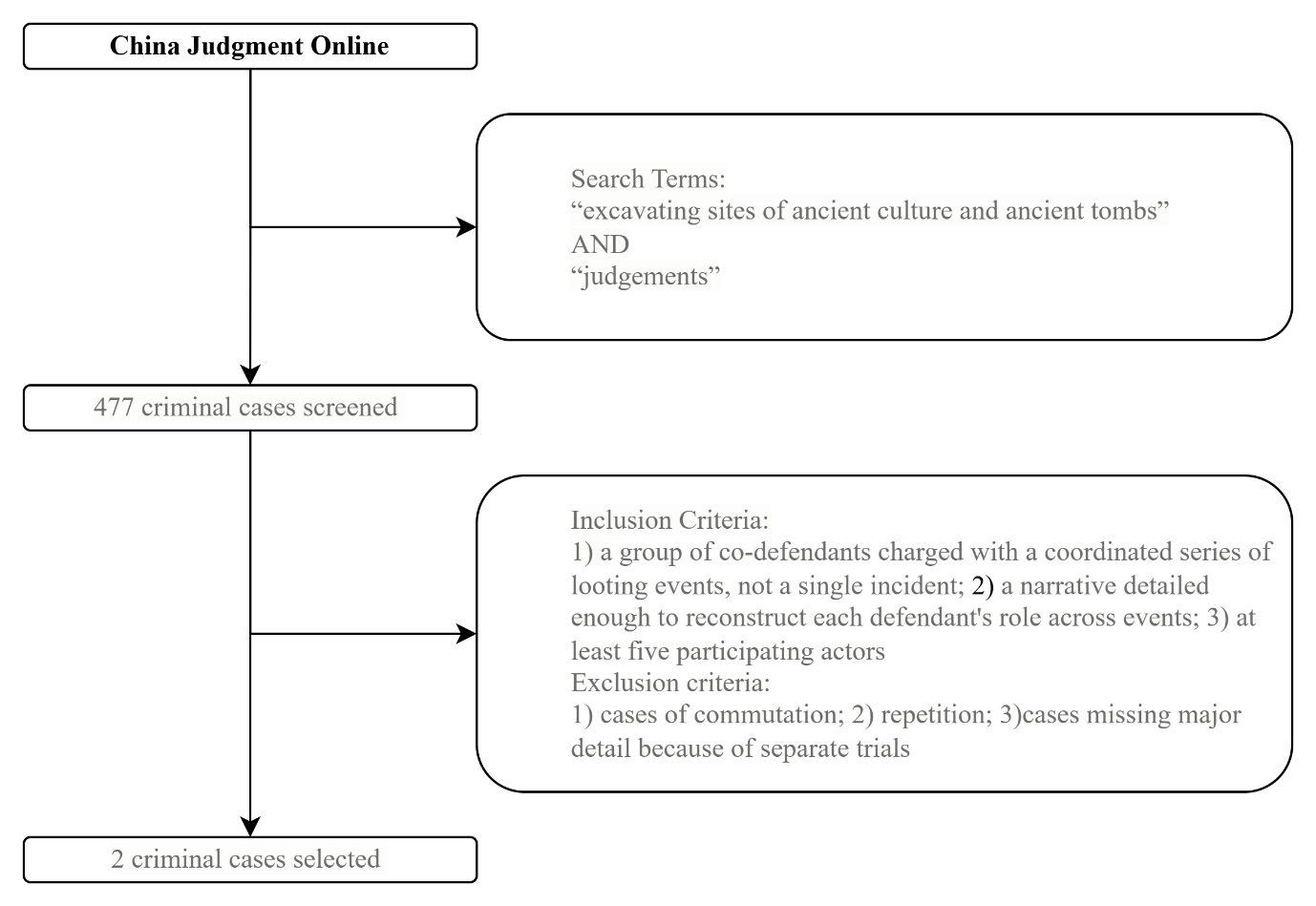
The two cases were identified through targeted keyword searches of the CJO database. Search terms combined the criminal category (tomb robbery, in Chinese 盗掘古文化遗址、古墓葬罪) with case-level filters that ensured the retrieved documents related to completed, multi-defendant prosecutions containing enough actor and event information to construct a network. The strategy followed the iterative, pilot-driven approach described by Tang and Cai (2021). Initial broad searches were refined through pilot screening to remove irrelevant documents such as sentence reduction decisions, retrial petitions, and single defendant cases.
Cases were retained only if the judgment satisfied three criteria at the same time. First, it had to concern an identifiable group of co-defendants charged in connection with a coordinated series of looting events rather than a single isolated incident. Second, the factual narrative had to be detailed enough to reconstruct individual participation across distinct criminal events, including the role taken by each named defendant. Third, the network had to involve at least five participating actors so that network-level statistics would be mathematically meaningful. Cases involving solitary offenders, administrative penalties, sentence reduction reviews, or significant missing details due to a separate trial are excluded.
These criteria returned two cases of unusual documentary richness, which the thesis calls Group A and B. Group A is a team of 33 actors who took part in seven prosecuted looting events. Its members are all non-local. They came together from outside the area, travelled to a series of distant sites, and hid their work behind cover businesses. In the terms of the spatial criminology set out in Chapter 2, Group A follows a commuter pattern, since its members leave their home ground to offend elsewhere. Group B is a smaller team of 17 actors across nine prosecuted looting events. It mixes local residents with a few outside specialists, and it works in and around the organiser’s home area. Group B therefore follows a marauder pattern, since it offends close to where its core members live. Together the two cases give a study population of 50 individuals and 16 events.
The thesis compares these two cases because they sit at opposite ends of this local-to-mobile contrast, which lets the analysis ask how a group’s spatial reach shapes the way it recruits, coordinates, and sells. The thesis does not include a third, purely local group. Such groups exist, but a purely local operation rarely leaves the kind of detailed, multi-defendant judgment that a network analysis needs, partly because the sale of looted relics pulls even a local team towards outside buyers. Group A and B are therefore not a complete typology of looting groups, but two well-documented and clearly contrasting cases, chosen for the depth of their records and for the distance between them on the dimension that the study sets out to explain.
The two cases also differ in how the offenders were represented in court. All 23 convicted members of Group A used court-appointed legal aid, while all 12 convicted members of Group B retained private counsel. This contrast gives the sentencing analysis an extra dimension, although the sentencing regression explains why this link cannot be read on its own.
Data Processing
Following Campana (2016), each case was coded as a two-mode (also called bipartite) actor and event matrix. The rows of the matrix represent individual offenders. The columns represent the distinct criminal events identified in the court judgment. A cell is coded 1 if the judgment records the actor as participating in that event and 0 otherwise. This matrix is the foundation on which all subsequent network analyses are built.
To construct the matrices, the primary researcher conducted structured textual data mining on the factual narrative sections of each judgment. Chinese court judgments follow a standard three-part structure: a case caption, a factual narrative, and a sentencing rationale. The factual narrative names defendants, describes each looting event in sequence, records who participated and in what capacity, and establishes the criminal roles on which charges are based. Both the actor and event matrix and the actor-level attributes were extracted from this section.
Extraction was manual rather than automated, following Feldman and Sanger (2007), because the specialised register of Chinese judgments and the need to link each named individual to each event demand close reading that automated tools cannot yet match at this scale, and because the modest size of each network makes manual coding both feasible and more accurate (Campana, 2016; Tang and Cai, 2021).
For each actor, the following attributes were also recorded: primary functional role or roles, age, place of origin (local or non-local to the crime site), education level, prior criminal history, gender, and custodial sentence in years. These attributes serve as covariates in the sentencing regression and as the basis for constructing predictor matrices in the network regression described in the section below.
With reference to factual narratives and Lanet al. (2024), each actor was assigned one or more of eleven roles, which were grouped into four operational stages, initiation, looting, assistance, and market, tracing the looting supply chain from extraction to sale; the roles and stages are defined in Chapter 4. Actors spanning more than one stage were flagged as multistage participants, and the number of stages in which an actor was active serves as a proxy for the depth of involvement, later the main predictor in the sentencing regression. All coding was done by the primary researcher, who took the most conservative reading of any ambiguous role.
Network Construction and Co-participation Analysis
Each two-mode actor-by-event matrix was projected into a one-mode co-participation network, in which the weight of a tie counts the events two offenders attended together (Borgatti and Everett, 1997; Campana, 2016). The ties are undirected, since the judgments do not show who influenced whom within an event. Following Campana (2016), a co-participation survival curve then records, for each threshold k, how many actors took part in k or more events. This curve is the primary test of H1: a steep decline, with most actors in only one or two events, is the market-style, supply-chain signature H1 predicts, while a flat curve, with the same actors returning across many events, would mark the cohesive, firm-like form H1 argues against. Comparing the two curves shows where each network sits on the firm-to-market continuum.
Social Network Analysis
For each network, degree centrality, the number of distinct co-participants an actor is connected to, measures the breadth of an actor’s collaboration (Morselli, 2009; Bright, Hughes and Chalmers, 2012). A high-degree actor has worked with many others, which marks a central organiser, while a low-degree actor is peripheral. Betweenness, closeness, and weighted strength were also computed, but in networks of this size they track the degree ranking closely and are not reported separately. Degree centrality and a Kamada-Kawai force-directed visualisation (Kamada and Kawai, 1989), with node size set by degree, are descriptive tools rather than formal tests: they locate the key actors and show whether a single organiser bridges the looting and market stages, the structure H1 describes.
Stage Density Analysis
A stage density analysis tests whether coordination concentrates within functional stages or spreads across them (Campana, 2016). For Group A, the density of ties within the looting stage, within the market stage, and across the two were compared. A high within-stage density set against a low cross-stage density is the structural signature of a division of labour and of an illicit supply chain, and this comparison is the second test of H1. For Group B the decomposition is only partial, because its market interface runs through a single organiser rather than a distinct market sub-group, which Chapter 4 reads as a sign of Group B’s more internalised, firm-like character.
QAP Regression
Coordination between offenders was modelled with a network regression using the Quadratic Assignment Procedure (QAP), which handles the non-independence of dyadic data through permutation-based inference (Krackhardt, 1988). The dependent variable is the logged count of events each pair of offenders attended together, so that stronger ties reflect more intensive cooperation. The predictors are dyad-level matrices recording whether two offenders shared a given attribute, and the sets differ between the groups to match the social structures in each judgment. For Group A they are: same looting stage, same tie type, same motivation, age difference, shared village origin, shared prison experience, and shared antique-trade circle. For Group B: same looting stage, same tie type, same motivation, age difference, both local, shared professional looting network, and shared migrant-worker status. The QAP regression is the study’s test of H2, asking whether coordination runs on locally rooted, task-specific ties rather than on a shared criminal record. It was run with the netlm function in the sna package, using 1,000 permutations (Butts, 2008).
Sentencing Regression
The sentencing regression examines what predicts the length of custodial sentences and carries the study’s tests of H3 and H4. The sample is the 35 convicted offenders with complete data, 23 from Group A and 12 from Group B, about 70 per cent of the convicted population; the rest were at large, deceased, or prosecuted without public documentation. Because several variables are ordinal and the sample is small, bivariate associations were first screened with Spearman correlations. Three ordinary least squares models were then fitted, adding predictors in turn: Model 1 uses only the number of operational stages an offender was active in, the depth-of-involvement measure that is the primary predictor of interest; Model 2 adds education; and Model 3 adds lawyer type. Lawyer type must be read with caution, because it is perfectly confounded with network, all Group A offenders using appointed counsel and all Group B offenders private counsel, so its effect cannot be separated from the network effect. A fourth model, Model 3b, repeats Model 3 without the 40-year outlier who organised Group B, to confirm that the involvement effect is not driven by that single case. These models test H3, while H4 is tested by stratifying the effect of a prior conviction by role.
Given the small sample, the study does not rely on significance thresholds. It uses non-parametric screening and permutation-based QAP where these fit, reports every coefficient with a 95 per cent confidence interval, and reads those intervals as estimates of uncertainty rather than as pass-or-fail tests.
Limitations
Two limitations bear directly on the network measures. First, court judgments capture only prosecuted offenders, so unobserved actors, in particular uncharged buyers at the market end, are missing, and the reported density and centrality figures are therefore lower bounds on the true structure (Morselli, 2009; Campana, 2016). Second, all individuals are named by role or by the neutral labels Group A and Group B, to avoid identification beyond the public court record. The wider limitations of sample size, case selection, and the selective release of court documents are taken up in Chapter 5.
Chapter 4
Findings
This chapter presents the empirical findings of the research and is organised around three connected questions. The first section profiles the two looting networks: who the offenders are, the scale of their operations, and the roles distributed across the criminal process. Then the second section examines how the networks are organised: whether they resemble informal family enterprises, internalised firms, or externalised market chains, and what social and operational ties drive coordination among offenders. The third section examines how the state responds, asking what legal and extra-legal factors predict the sentences that the courts impose. Lastly, a summary draws these threads together.
The three sections build a single empirical argument with two implications for broader literature. The first is theoretical. By applying Campana’s (2016) social network framework to a domestic Chinese offence, this research tests whether the firm-versus-market distinction developed in the context of transnational human trafficking holds in a setting shaped by Guanxi, kinship, and rural-urban migration rather than by ethnicity and cross-border movement. The second implication is conceptual. The findings presented show that contemporary Chinese tomb looting displays the defining empirical features of organised crime: high-level division of labour across specialised roles, a structured supply chain from underground extraction to market-stage trade, and coordination patterns driven by purposeful, task-specific bonds rather than by opportunity or shared marginality. On this empirical basis, this research argues that contemporary Chinese tomb looting is better understood as organised crime than as a spontaneous or opportunistic rural offence.
Profiling the Two Looting Networks
The total number of offenders across the two looting networks that committed 16 looting events is 50, of which 33 are from Group A and 17 from Group B. On average, each looting event involved 7.1 offenders. Group B has, on average, fewer participants in each event (5.9 compared to 8.9).
Beyond the difference in network size, the temporal pattern of the events also differs sharply. In the smaller group B, all 9 events were compressed into roughly six months through the second half of 2014. In the larger Group A, the 7 prosecuted events span 6.5 years, from mid-2011 to early 2018. Group B’s events typically last no longer than three days, while Group A’s activities last one to six months.
The two groups also target different types of sites. Group B, without underground digging expertise, targets outdoor and open-air archaeological sites. Group A, drawing on technical experience, targets architecturally protected underground chambers typically five to eight metres deep. Without protection, for Group B, around 20 offenders can damage 10 to 20 archaeological sites and create more than 300 pits in a year, while for Group A, around 30 offenders can damage around 3 sites by digging tunnels several metres deep and hundreds of metres long. Although the documented success rate of looting events is lower than expected (approximately 45%), unsuccessful attempts still threaten the archaeological sites. The Chinese courts apply the maximum statutory sentences to key participants in both networks, including life imprisonment in group B and 15 years in group A. Both groups can therefore be viewed as examples of high-capacity looting networks.
Table 4.1 summarises the demographic, behavioural, and sentencing characteristics of the offenders.
| Variable | Group A (N=33) | Group B (N=17) | Total (N=50) | |
|---|---|---|---|---|
| Gender | Male | 32 (97.0%) | 16 (94.1%) | 48 (96.0%) |
| Female | 1 (3.0%) | 1 (5.9%) | 2 (4.0%) | |
| Age** | Range | 32–55 | 26–54 | 26–55 |
| Mean (SD) | 41.6 (6.2) | 41.6 (8.1) | 41.6 (6.8) | |
| Origin | Local | 0 (0.0%) | 10 (58.8%) | 10 (20.0%) |
| Non-local | 33 (100%) | 7 (41.2%) | 40 (80.0%) | |
| Education** | ≤ Middle school | 19 (82.6%) | 12 (100%) | 31 (88.6%) |
| ≥ High school | 4 (17.4%) | 0 (0.0%) | 4 (11.4%) | |
| Criminal History** | Prior convictions | 13 (56.5%) | 2 (16.7%) | 15 (42.9%) |
| Stage* | Initiation | 7 (21.2%) | 4 (23.5%) | 11 (22.0%) |
| Looting | 12 (36.4%) | 15 (88.2%) | 27 (54.0%) | |
| Assistance | 6 (18.2%) | 5 (29.4%) | 11 (22.0%) | |
| Market | 14 (42.4%) | 2 (11.8%) | 16 (32.0%) | |
| Sentencing | Range (yrs) | 0–15 | 0–40 | 0–40 |
| Mean (yrs) | 7.5 | 6.3 | 7.1 | |
| Total fines (CNY) | 3,285,000 | 1,000,000 | 4,285,000 |
Note. Values are N (%) unless otherwise stated. * Individuals may participate in multiple stages, so percentages may sum to more than 100%. ** Percentages based on cases with available data.
Men make up more than 95% of the criminal network, consistent with Lanet al. (2024). The average age is 41.6 years, with both groups showing similar means. More than 80% of offenders with documented education attained at most a middle-school level, again consistent with Lanet al. (2024). Where employment data is available, all convicted offenders in group B are farmers or unemployed. The demographic profile that emerges is one of middle-aged men with low formal education and unstable income engaged in the looting stage.
Drawing on Lanet al. (2024: 1862) and the court records, the analysis identifies eleven roles: intelligence, investor, organiser, recruiter, technician, digger, driver, lookout, cover, broker, and buyer. Because a key offender may hold three to five roles simultaneously, these eleven roles are regrouped into four sectors of the looting operation: initiation, looting, assistance, and market. Initiation covers the preparation of looting events (intelligence, investor, organiser, recruiter). Looting refers to the digging process (diggers and technicians). Assistance includes driver, lookout, and cover, who support but do not participate in the digging itself. Market covers brokers and buyers, who handle the transport, resale, and final purchase of looted antiquities. A person who buys and resells antiquities or who introduces a looter to a buyer is coded as a broker; a buyer is the final purchaser who normally self-identifies as an art collector. The four-stage scheme captures the structure of a standard antiquities trafficking supply chain from underground extraction to final sale.
Network Structure and Coordination
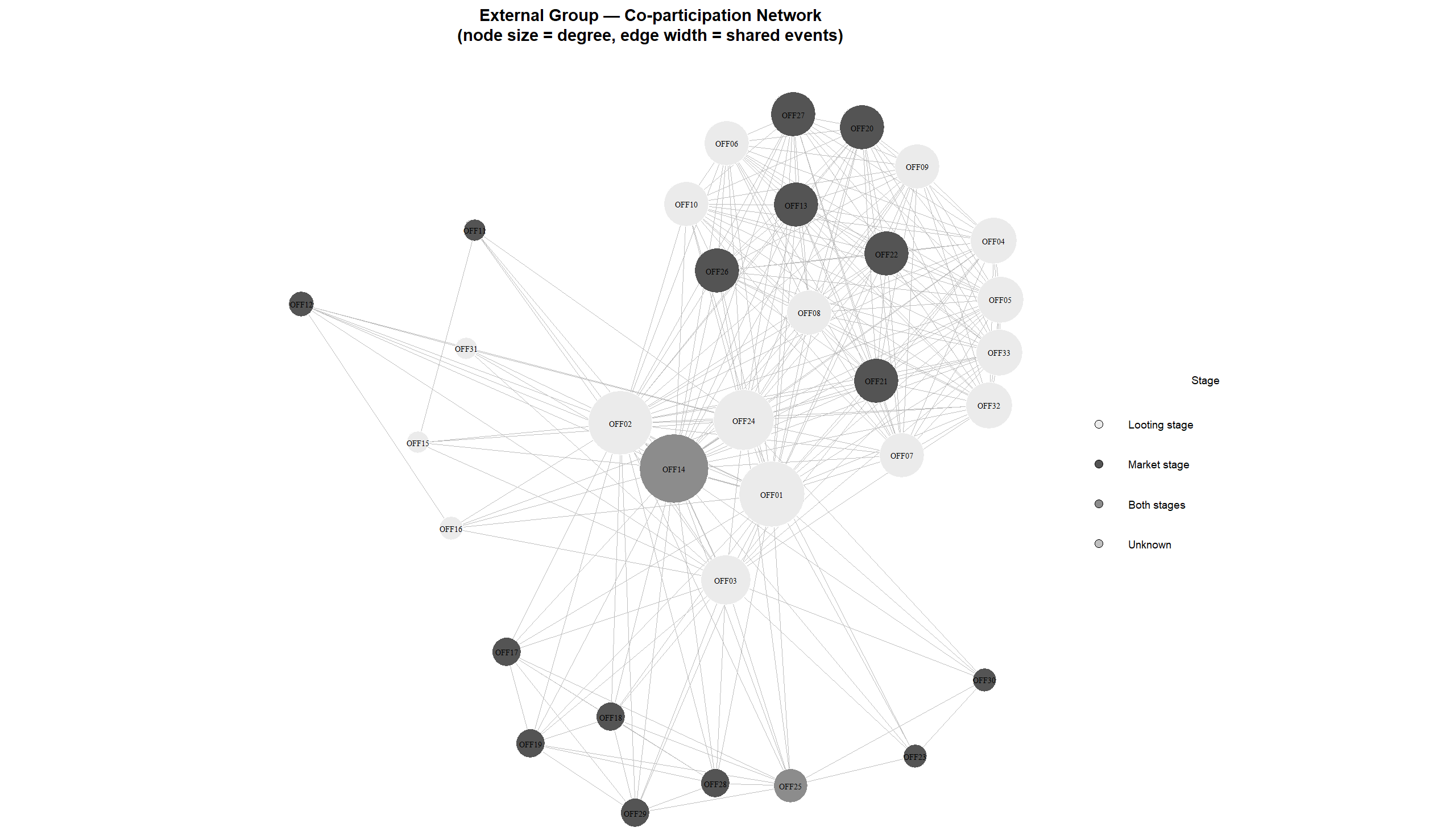
Figure 4.1 presents force-directed visualisations of the two looting networks. Each dot represents an individual: offenders who participated in looting are plotted in white, offenders in the market stage in dark grey, and offenders in both stages in grey. The graph uses the Kamada-Kawai (1989) algorithm, in which nodes connected by a tie are drawn near each other. The size of each node indicates its degree centrality. OFF14 in Group A and OFF01 in Group B stand out as the most central actors. Both organise looting events, span looting and market stages, and receive the most severe penalties in their groups.
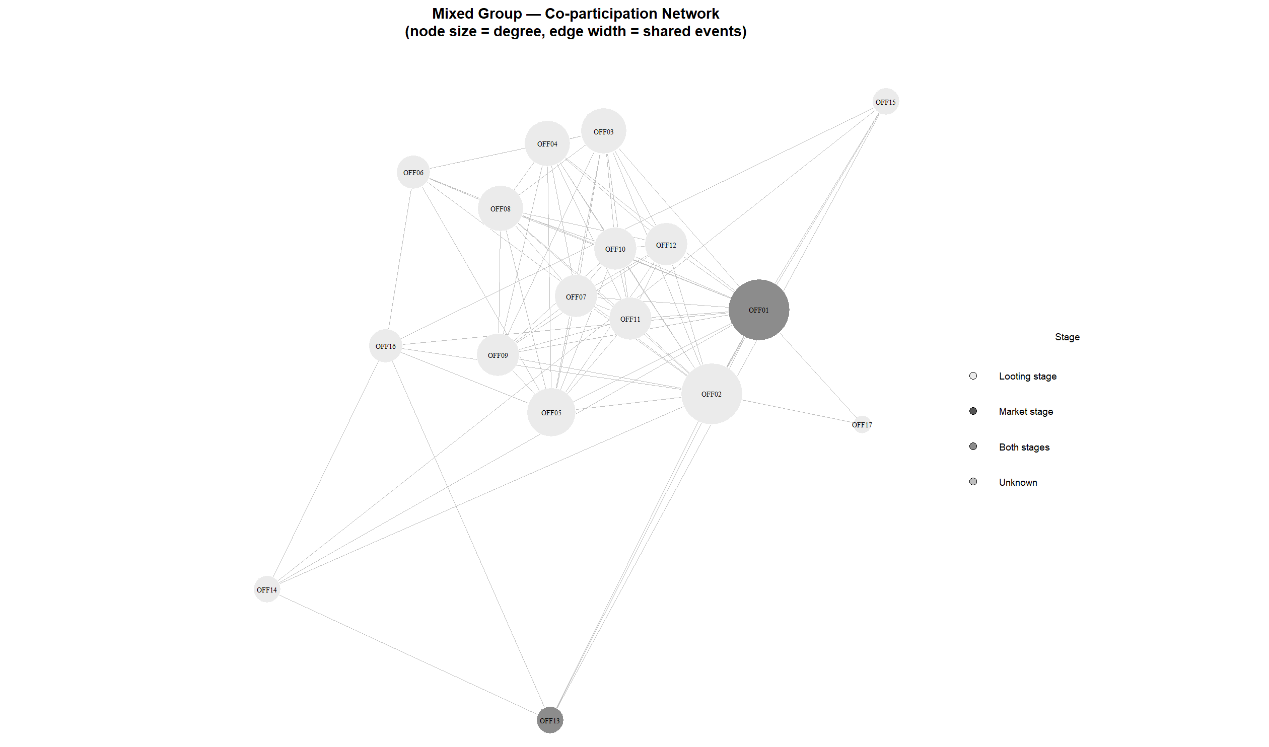
Looting only Market only Both stages Node size ∝ degree centrality
In group B, OFF02 also appears central and very close to OFF01, suggesting a single close assisting actor supporting the main offender. In group A, three relatively large nodes (OFF01, OFF02, OFF24) cluster around OFF14, suggesting the main offender works with multiple close assistants. Many brokers, buyers, and diggers appear peripheral, indicating that most are involved in only one looting event before leaving the network.
Following Campana (2016), Figure 4.2 plots the pattern of co-participation across the 16 looting events. The figure tests whether each network is more internalised, with a stable group repeatedly committing crimes together, or more externalised, with offenders co-participating in a smaller number of events. According to Campana (2016: 78), an internalised group resembles the firm model, while an externalised group resembles the market model (Coase, 1937).
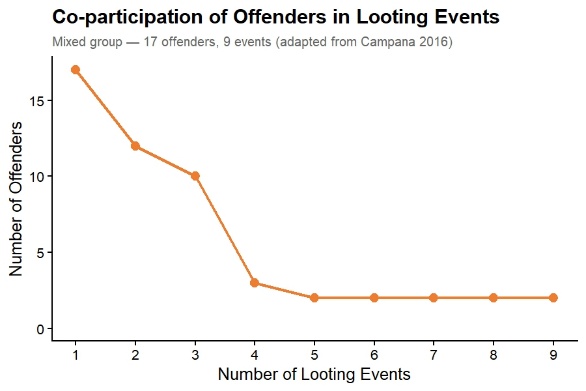
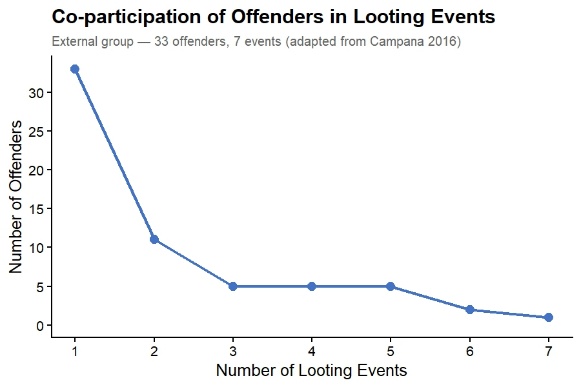
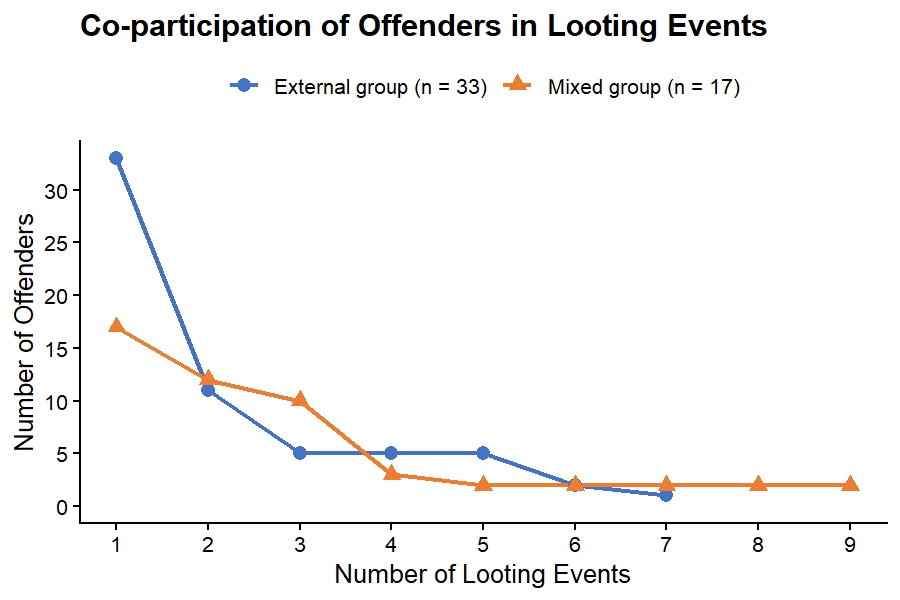
Both networks show the expected decay: most offenders participate in very few events, and repeat participation drops sharply. Group A strongly aligns with Campana’s findings: of 33 offenders, fewer than half were jointly involved in two events, and co-participation drops significantly as the number of events increases. Group B, by contrast, shows a higher level of internalisation, with a slower decline in co-participation.
Within both networks, a tie between two offenders indicates participation in the same looting event together. Following Campana (2016), the more events two offenders share, the greater their coordination. Table 4.2 reports QAP regression results predicting tie strength from a set of shared-attribute matrices, including stage, motivation, age difference, and pre-existing network membership.
| Variable | Group A Coef. | Group A p | Group B Coef. | Group B p |
|---|---|---|---|---|
| Intercept | 0.369 | 0.000 *** | 0.385 | 0.074 † |
| Same stage | 0.097 | 0.102 | −0.300 | 0.160 |
| Same motivation | 0.262 | 0.002 ** | 0.204 | 0.176 |
| Age difference | −0.003 | 0.564 | 0.039 | 0.000 *** |
| Both: village network | 1.173 | 0.000 *** | 0.087 | 0.630 |
| Both: prison network | 0.013 | 0.878 | — | — |
| Both: antique trade circle | 0.072 | 0.508 | — | — |
| Both: professional network | — | — | 0.977 | 0.000 *** |
| Both: migrant network | — | — | 1.034 | 0.000 *** |
| Adjusted R² | 0.089 | — |
QAP regression for network data. *** p<.001, ** p<.01, * p<.05, † p<.10. Group B n = 136 dyads — interpret with caution.
Three patterns emerge. First, age difference matters in group B but not group A. Pairs of offenders further apart in age are more likely to work together in group B (coefficient = 0.039, p<.001), indicating a seniority-based hierarchy. Second, shared local ties matter in group A but not group B. Being from the same village is the strongest predictor of coordination in group A (coefficient = 1.173, p<.001). The court records show that the key organiser built his core team by recruiting people from his own village, who then travelled together to operate far from their place of origin. Third, general criminal history does not drive coordination, but looting-specific ties do. Prison acquaintance and antique trade circle membership are not significant predictors in group A. In group B, the key offender brought a professional looting network and two migrant workers to his hometown, and both ties significantly predict coordination. These patterns support H2: coordination rests on locally rooted, task-specific ties, namely shared village origin, looting skill, and migrant networks, rather than on a shared criminal record or prison acquaintance.
The division of labour is visible at the actor level. Diggers in group A do not primarily coordinate with other diggers; they coordinate upward with the organiser and horizontally with the cover and driver who support operations. Brokers and buyers in the market stage coordinate almost exclusively with the organiser who brings them the looted goods. A buyer (OFF19) in event 04 never meets any digger; he only deals with OFF14. In event 06, two brokers (OFF13 and OFF26) resold antiquities for approximately £180,000 in profit without any operational contact with the looters. The network resembles an illicit antique trafficking supply chain rather than a criminal gang, with each actor knowing only the link immediately above and below them.
This supply-chain structure is also visible in stage-level coordination densities. Actors in the looting stage coordinate intensively, producing an intra-looting density of 0.744 in group A. Actors in the market stage barely coordinate with one another, yielding an intra-market density of only 0.248. The operational stage is where the real coordination happens; the market stage is where independent demand absorbs the output. Across the sharp co-participation decay, the single organiser who bridges the two ends, and this dense looting stage set against a sparse market stage, both networks behave as illicit supply chains rather than as cohesive gangs or family clans, as H1 predicts.
Sentencing Outcomes
The sentencing analysis covers 35 convicted offenders, 23 from group A and 12 from group B. This represents approximately 70% of the convicted offenders in both networks; the remaining 30% are at large, deceased, or prosecuted without public documentation. The findings here are insightful but not conclusive and highlight the need for further systematic investigation with larger samples.
Figure 4.3 shows the mean imprisonment and mean fines by primary role across both groups. Role hierarchy structures sentencing similarly in both networks, with organisers receiving the longest imprisonment and the largest fines. In group A, mean imprisonment ranges from 15.0 years for the organiser down to 3.9 years for brokers, with covers (10.6), investors (10.5), and diggers (7.4) clustering in the middle. Group B shows the same ordinal pattern: organiser (40 years) > digger (4.1) > recruiter (1.5) > driver (0), but with a markedly wider spread driven by the 40-year life-equivalent sentence imposed on the sole organiser (OFF01).
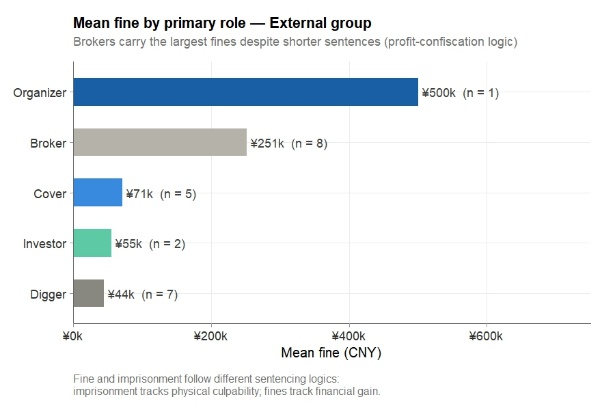
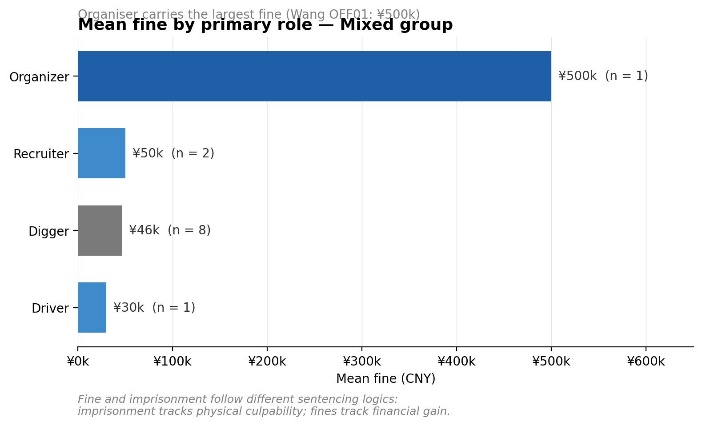
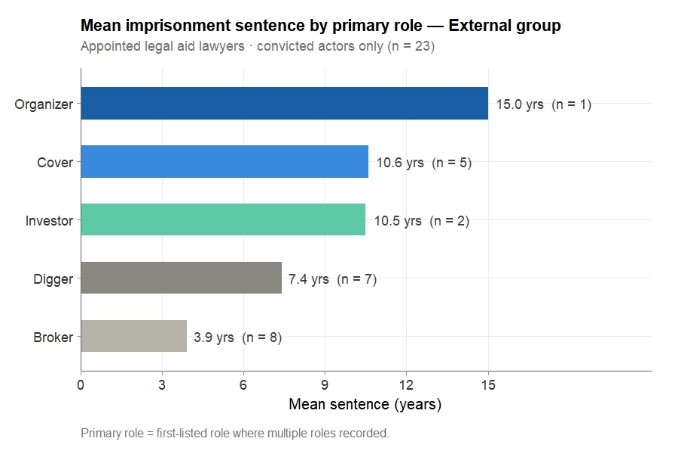
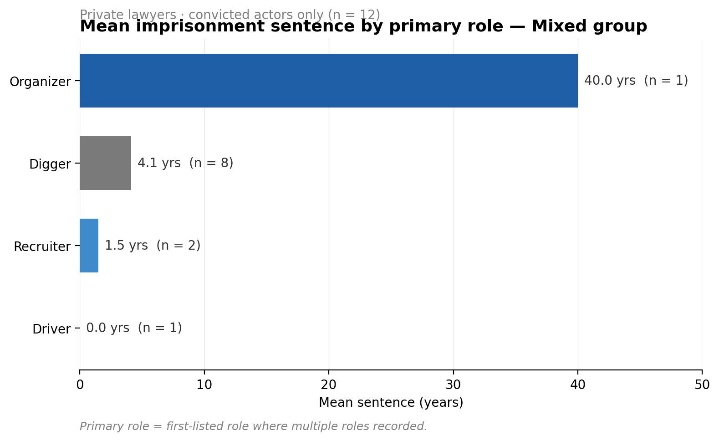
A second pattern emerges when fines are compared against imprisonment within the same role. In group A, brokers received the second-largest mean fine (¥251k, n = 8) despite the shortest mean sentence (3.9 years), while diggers showed the inverse pattern (¥44k fine, 7.4 years). Imprisonment appears to track physical culpability while fines appear to track financial gain. Group B preserves this dual-axis logic in compressed form: OFF01, who combined organising, looting, and selling, received the longest sentence and the largest fine (¥500,000), while supporting roles received fines clustered narrowly between ¥30,000 and ¥50,000.
Education shows a weak, non-monotonic relationship to sentence length in both groups (Group A: Spearman r = 0.09, ns; Group B: r = 0.16, ns; Figure 4.4). The mean sentence rises modestly from primary to high school in group A and then falls again at university level, a pattern driven by two university-educated brokers (OFF13 and OFF19) whose sentences (3 and 5 years) were comparatively light. Lawyer type is fully confounded with network in this dataset: all 23 group A offenders used appointed legal aid, while all 12 group B offenders retained private counsel. A direct test of the lawyer-type effect is therefore impossible without controlling for network, and the OLS regression including both predictors produces collinear estimates that cannot be reliably interpreted (Table 4.3, M3: B = −2.30, 95% CI [−5.98, 1.38], ns).
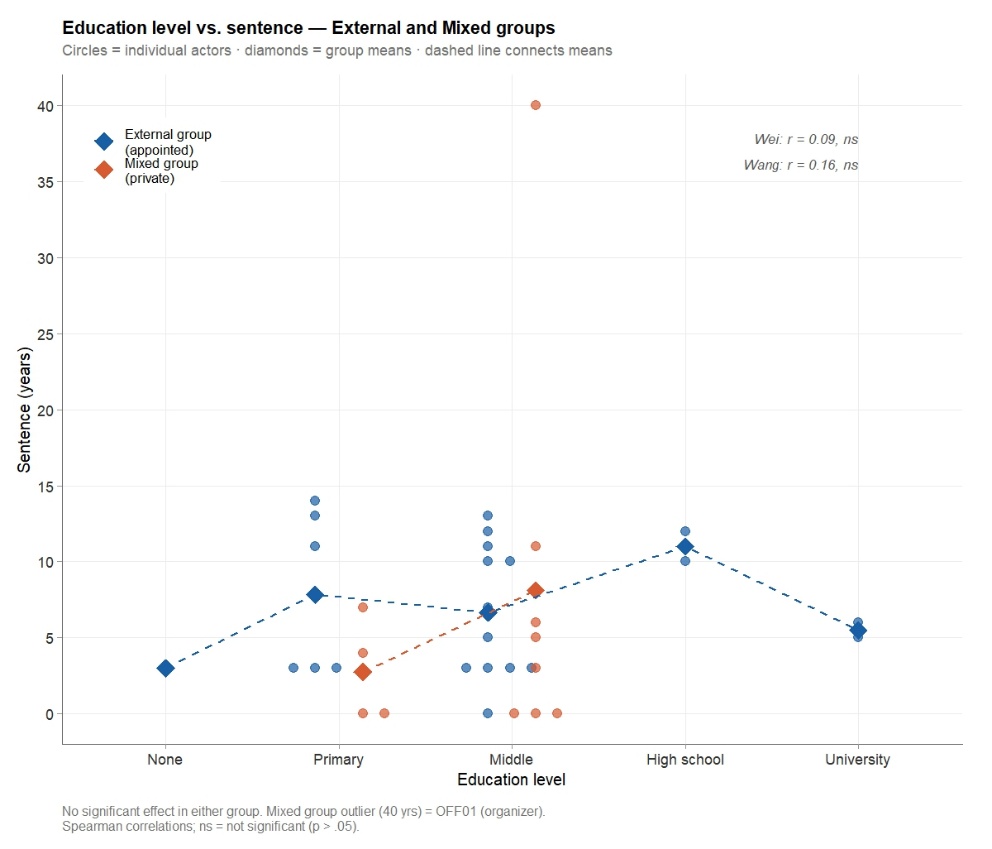
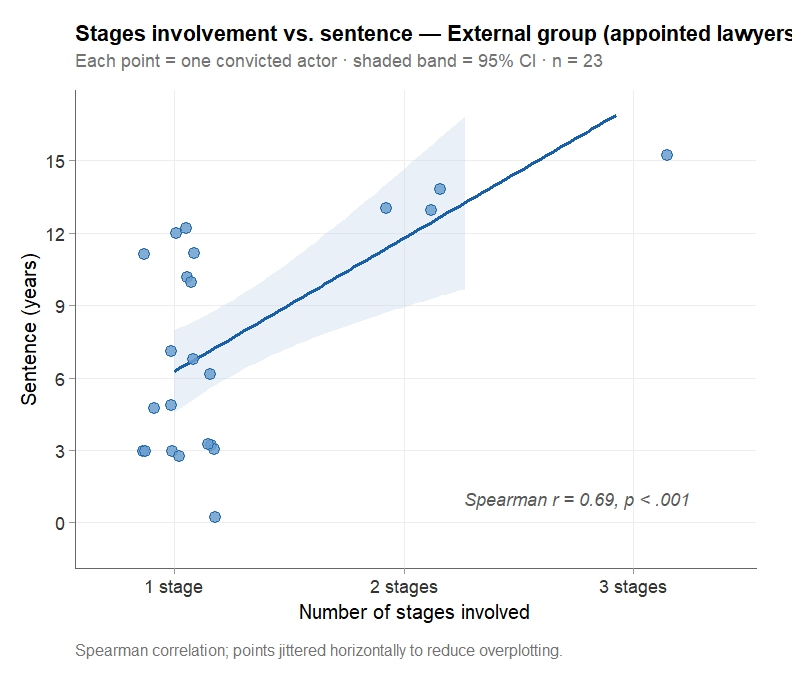
Figure 4.5 and Table 4.3 show that the number of stages an offender participated in is a strong and robust predictor of sentence length. The Spearman correlation is r = 0.66 (p < .001), a large effect size. OLS regression confirms that each additional stage is associated with approximately eight additional years of imprisonment in group A (M1: B = 8.05, 95% CI [5.46, 10.63], p < .001). This effect is essentially unchanged after controlling for education (M2: B = 8.04) and lawyer type (M3: B = 8.22). The full model explains 55 to 58 per cent of the variation in sentence length, which is high for sentencing research with this sample size. Excluding the OFF01 outlier reduces but does not eliminate the effect (M3b: B = 3.93, p < .01), confirming the relationship is not an artefact of a single case. What the offender did across the criminal process predicts sentence length far more reliably than any biographical attribute considered above. This is the evidence for H3: the breadth of an offender’s involvement, measured by the number of operational stages, predicts sentence length more strongly than any biographical attribute.
| Predictor | M1: Involve. | M2: +Educ. | M3: +Lawyer | M3b: Excl. outlier |
|---|---|---|---|---|
| Intercept | −3.49 (−7.30, 0.32) | −4.85 (−10.23, 0.54) | −4.02 (−9.52, 1.48) | 1.92 (−3.18, 7.01) |
| Stages involved | 8.05 (5.46, 10.63)*** | 8.04 (5.43, 10.64)*** | 8.22 (5.62, 10.82)*** | 3.93 (1.11, 6.76)** |
| Education (0–4) | 0.76 (−1.35, 2.88) | 0.60 (−1.51, 2.72) | 0.32 (−1.34, 1.99) | |
| Lawyer (private=1) | −2.30 (−5.98, 1.38) | −3.82 (−6.79, −0.85)* | ||
| R² | 0.55 | 0.56 | 0.58 | 0.36 |
| N | 35 | 35 | 35 | 34 |
Cells show B (95% CI). * p<.05, ** p<.01, *** p<.001. Lawyer coded 1 = private (Group B), 0 = appointed (Group A). M3b excludes OFF01 (40-yr outlier).
Article 65 of the Chinese Criminal Law treats a prior conviction within five years of release as an aggravating factor that mandates harsher sentencing (Tang and Cai, 2021). The data confirms this provision operates in practice, but unevenly. Pooling both networks and excluding the OFF01 outlier, actors with a prior conviction received, on average 7.86 years of imprisonment compared to 4.90 years for those without, a difference of nearly three years. Fines were almost unaffected. Stratifying by role reveals that this aggravating effect is concentrated among offenders who performed the physical labour of looting and is reversed or absent among those operating in the market chain.
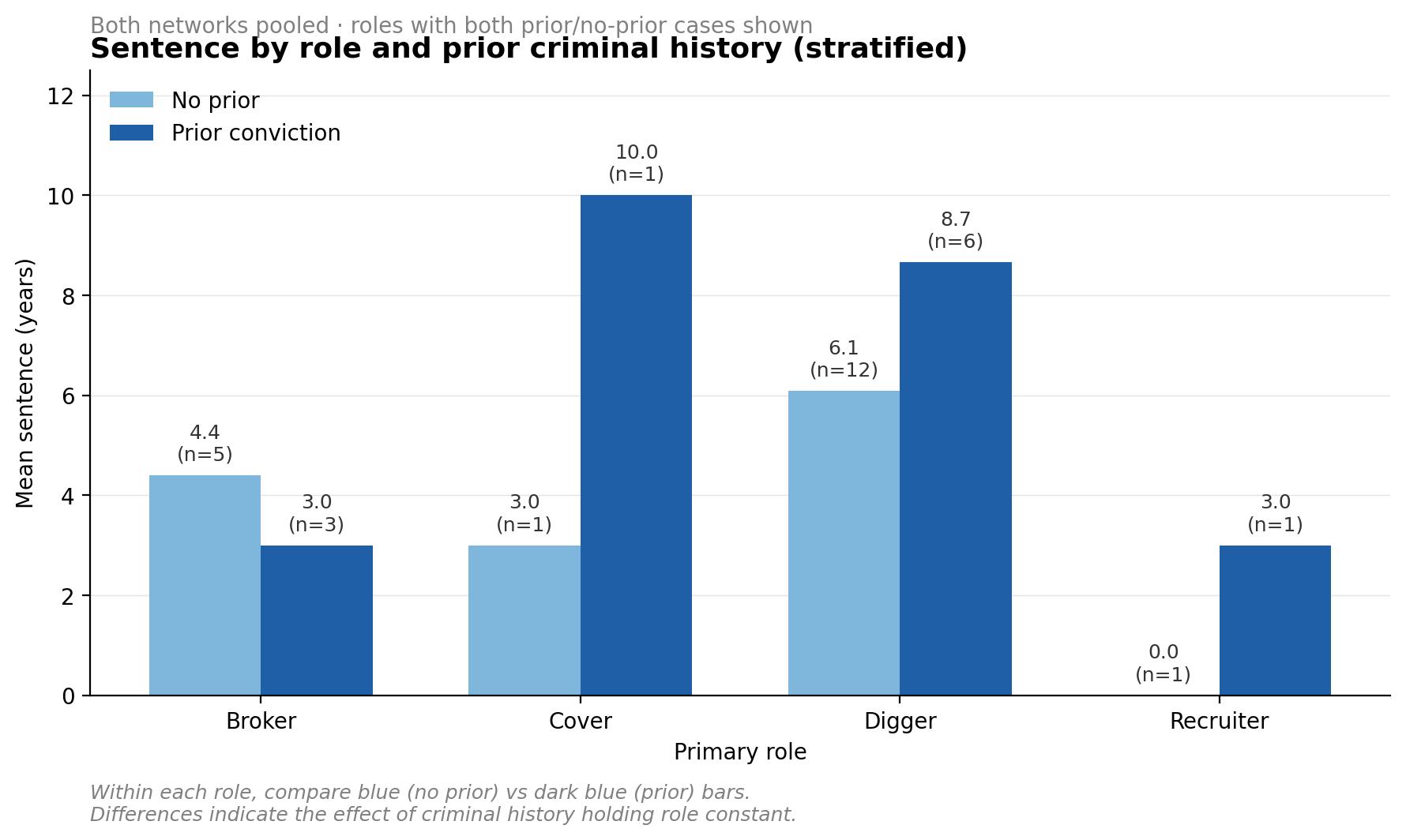
Figure 4.6 shows the pattern across roles. For diggers, the mean sentence rises from 6.1 years (no prior, n = 12) to 8.7 years (with prior, n = 6), a difference of 2.6 years. For covers, the contrast is sharper at 3.0 versus 10.0 years, though the small n means this should be read as illustrative. The recruiter category also shows an upward shift, from a suspended term to 3 years. Brokers, however, show the opposite pattern: brokers without a prior record received 4.4 years (n = 5), while brokers with a criminal history received only 3.0 years (n = 3). Figure 4.7 confirms this at the individual level: the digger and cover lines slope upward from no prior to prior-conviction, while the broker line slopes downward.
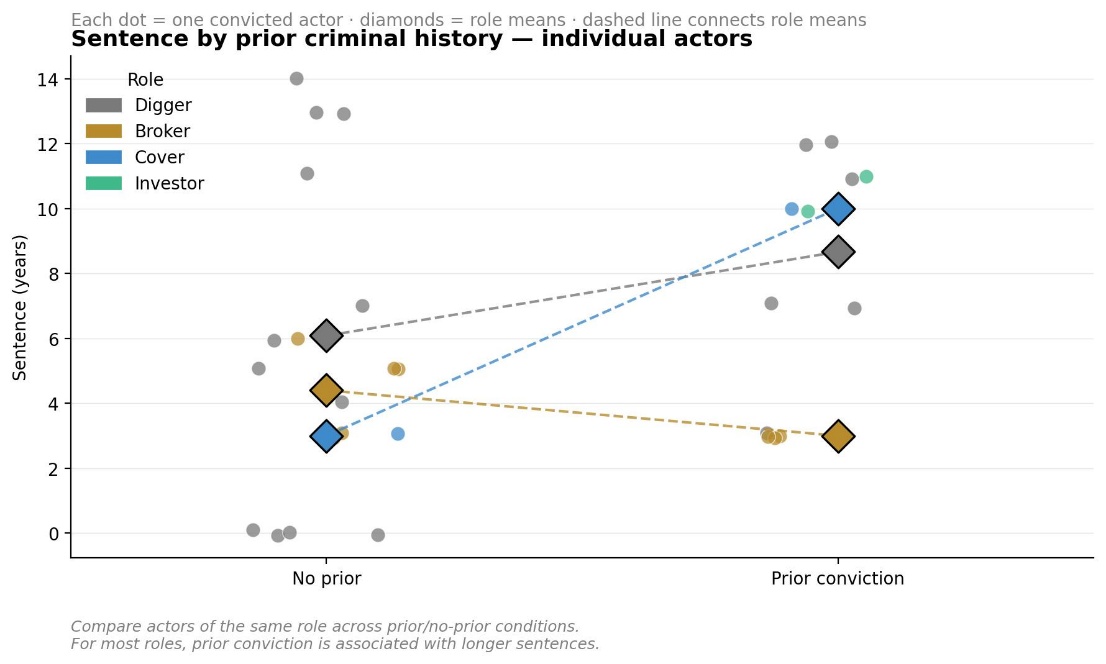
In summary, the criminal history findings show that the aggravating logic of Article 65 operates unevenly across the looting network. For executors, diggers, covers, and recruiters, a prior conviction adds roughly two to three years of additional imprisonment. For brokers, this premium disappears and may even reverse. This uneven pattern is the evidence for H4: the weight a prior conviction adds depends on an offender’s position in the supply chain.
Summary of Findings
Three key findings emerge from this analysis. First, the two networks are best understood not as two unrelated organisational forms but as two stages of a single growing enterprise. Group B operates as a localised, hub-and-spoke enterprise rooted in the organiser's home community, with a smaller core and a compressed operational timeline. Group A operates as a mobile, village-based team that travels far from its place of origin and uses cover businesses to disguise its activities, with a larger core, a longer operational timeline, and a more developed market-stage presence. Both share the demographic profile commonly associated with organised property crime in rural China. The differences in scale, duration, and target type between them are consistent with a process in which a localised looting group accumulates resources, recruits beyond the village, and grows into a mobile, market-facing enterprise.
Second, coordination within both networks is structured around purposeful, task-specific relationships rather than around shared marginality. General criminal history and prison acquaintance do not predict who works with whom; shared village origin, professional looting experience, and migrant network membership do. The intensive coordination among looting-stage actors, the parallel and isolated activity of market-stage brokers and buyers, and the routing of major coordination through a single organiser collectively support the interpretation of both networks as illicit supply chains rather than as criminal gangs or family enterprises. This pattern broadly aligns with Campana’s (2016) findings on human-trafficking networks, with one notable departure: in the Chinese context, coordination is shaped by Guanxi, kinship, and rural-urban migration rather than by ethnicity and cross-border movement.
Third, the formal sentencing response treats these offences with the severity reserved for serious organised crime. Role hierarchy structures sentence length, imprisonment and fines follow distinct logics, and the number of stages an offender participated in is the strongest predictor of sentence severity. Prior criminal history adds a recidivism premium for offenders performing the physical labour of looting but disappears among market-side brokers. The court records suggest that this pattern is driven by voluntary surrender: brokers and buyers, on hearing of the arrests through public news coverage, frequently turn themselves in and qualify for the statutory mitigation associated with self-surrender. Market-side actors are therefore mitigated not through legal sophistication but through their structural position at the visible end of the supply chain, which gives them advance warning that the operational core has been disrupted.
Overall, these findings sustain a single empirical claim: considering structure and sentencing, tomb looting in contemporary China is a complex criminal enterprise that the Chinese state itself recognises as such through its sentencing practice. The Discussion chapter situates this claim within the broader theoretical literature.
1 Note. Several figures in this chapter were produced in R before the group labels were finalised, and they still read “external group” and “mixed group”. These map onto the names used in the text: the external group is Group A, and the mixed group is Group B. The original names described each group’s make-up. Group A was called the external group because all of its members are non-locals recruited from outside the crime area, whereas Group B was called the mixed group because it combines local residents with a few non-local specialists.
Chapter 5
Discussion
The previous chapter established a single empirical claim across three connected lines of analysis: contemporary Chinese tomb looting displays the defining features of organised crime, a clear division of labour across specialised roles, a supply chain that runs from underground extraction to market-stage trade, and coordination driven by purposeful, task-specific ties rather than by chance or shared disadvantage. This chapter moves from describing those patterns to explaining them and draws out what they contribute to the study of organised crime in and beyond China.
The chapter develops three contributions to organised-crime theory. First, it argues that organised crime is better understood as coordination than as organisation: these groups hold together not through a stable, mafia-like body but through the way independent actors coordinate a trade. Second, it shows that cultural mechanisms can substitute for formal hierarchy, since the networks rely on Guanxi and shared local origin to secure the trust that a firm secures through managerial direction. Third, it shows that sentencing outcomes reflect judicial narratives and an offender’s position in the chain, not culpability or structural power alone. Taken together, the thesis demonstrates that looting groups operate through relationally embedded, market-like coordination, which challenges the assumption that organised crime necessarily entails stable organisation.
The discussion runs in four parts. The first section below reads the offender profile, its age, occupation, and gender, against the rural-poverty setting of contemporary China, and contrasts the Chinese case with Balcells’s (2023) Italian tombaroli. The section that follows develops the coordination reading and asks what Guanxi adds to Campana’s (2016) economic account of the firm and the market. A third section turns to sentencing and to the pattern found among brokers. A closing section then draws the threads together, considers the implications for policing, and sets out the study’s limitations and directions for future work.
Rural Poverty, Profit Motivation, and the Italian Comparison
This section interprets the offender profile set out in Chapter 4, and argues that each of its features, age, occupation, and gender, points towards a profit-oriented criminal enterprise rather than an opportunistic rural pastime. The demographic profile, predominantly middle-aged men with low formal education and unstable income, invites closer interpretation. The average age of 41.6 years is unusually high in the context of life-course criminology, which typically associates property offending with younger offenders. This deviation has a substantive explanation rooted in the demands of the illicit antiquities market itself. It is unrealistic for young men to dig and sell cultural relics, because they do not have the technical knowledge to identify valuable items, nor do they have access to the network of potential buyers. In addition, buyers in the antiquities market are unlikely to trust a seller in their twenties to deliver a genuine and valuable artefact. The age structure of these networks therefore reflects the credibility and knowledge demands of the criminal trade rather than any departure from broader patterns of life-course offending.
If the age structure reflects the knowledge that trade demands, the occupational profile reflects the economic pressures that drive it. The occupational profile, of farmers and unemployed individuals, similarly demands interpretation in light of the broader rural-poverty context. Without stable income, engagement in illicit activities is primarily motivated by money, and a lack of legal awareness may compound the economic motivation. This profile aligns with the profit-oriented logic that the criminological literature commonly associates with organised property crime. The Chinese case, however, contrasts sharply with Balcells’s (2023) account of the Italian tombaroli. Balcells (2023: 6) suggests that the Italian tombaroli did not gain considerable profit from digging, and that they are part-time looters who use the proceeds to round off salaries or compensate for a bad agricultural season (ibid.: 9). On this basis, Balcells disassociates Italian tomb looting from organised crime. The Chinese evidence shows a different picture because the gap between Chinese and Italian farmers’ earnings is substantial. The profit from tomb looting can constitute a significant income for Chinese farmers, as the Chinese government did not declare an end to rural extreme poverty until 2020 (see Feng, Robinson and Tan, 2025). The economic conditions of rural China therefore make tomb looting a more economically rational activity than its Italian counterpart and bring it closer to the profit-oriented logic of organised crime rather than the supplementary-subsistence framing offered by Balcells.
Within this profile, the place of women repays closer attention, even though only two of the fifty offenders are female, so what follows is a qualitative observation rather than a statistical claim. Both women worked at the assisting edge of the operation, one as a driver and one as the keeper of a breakfast shop that screened a digging site, and both entered the network through an intimate tie to a central male organiser, as a girlfriend or an in-law, rather than through the wage or profit motive that drew the men. This fits the pattern that the co-offending and gender literature describes. Søgaard and Bræmer (2023), studying recreational drug dealing, find that women’s participation is typically mediated by personal relationships with central male actors rather than by direct economic ambition, and the two cases here match that account closely. Gendering runs deeper than recruitment. The physically demanding, high-trust core of the trade, the underground digging on which the whole enterprise depends, is performed exclusively by men, so women are confined to the visible, supporting margins. Read through the lens of power, this division of labour is not incidental: it expresses who is trusted with the risky and valuable work and who is kept at its edge. Far from disrupting the picture of a structured criminal enterprise, then, the position of women reinforces it, since gender, like age and occupation, reflects how the network recruits and places its members according to the needs of a profit-driven trade. This raises a further question, how that trade is organised, and it is to the organisational logic of the two networks that the discussion now turns.
Extending Campana: Organisational Logic and the Supply Chain
The QAP regression results reported in Chapter 4 align broadly with Campana’s (2016) framework but also depart from it in instructive ways. Campana’s theory rests on economic logic and rational choice, holding that the degree of externalisation in a criminal organisation is determined by the economic concern of reducing monitoring costs. The findings here are rooted in the more subtle social and Guanxi culture of the Chinese context, and the comparative data therefore add an alternative explanation: network type predicts co-participation patterns through pre-existing social structures, not only through economic optimisation. Group B, which operates within the organiser’s home community, resembles a family business in its highly internalised structure, frequent co-participation, low demand for external labour, and absence of outsider participants. Repeat co-offending in this group is driven by social obligation and by trust embedded in pre-existing relationships rather than by managerial direction. Group A, led by non-locals, is by contrast organised around the goal of maximising the profit of tomb looting: recruiting accordingly, finding investors and potential buyers, and cutting expenses.
Guanxi here is neither generic trust nor Campana’s ethnicity. Trust in the abstract can bind any two parties, and in Campana’s Nigerian ring ethnicity did not drive coordination at all. Guanxi is more specific: a web of reciprocal obligation rooted in shared origin and kinship that lets people cooperate without formal organisation to enforce their agreements. In transaction-cost terms it lowers the cost of monitoring a partner who cannot be taken to court, but it does so without requiring organisational integration; it substitutes for hierarchy rather than building it. This is why the home-based Group B sustains repeated cooperation without managerial direction, while the mobile Group A, lacking such ties, must instead pay and replace its labour. The contribution can therefore be put as a relational extension of the firm-market model, in which pre-existing social ties, not only monitoring costs, decide where a network sits between firm and market.
The economic logic of group A also explains why diggers do not tend to co-participate across many events. The only motivation of highly mobile diggers is their wage, and because there are no deep social ties they will not receive a substantial salary increase through repeated participation. Because digging is labour-intensive, individual diggers are easily replaceable and so have little motivation to participate repeatedly. In addition, a digger who has participated two or three times may expect a wage increase, while a first-time digger may be more desperate for income and accept lower pay. The first-time digger is therefore cheaper labour and more attractive to the organisers. As a result, the co-participation level is lower in Group A. In Coase’s (1937) terms, group A operates closer to the market model while group B sits closer to the firm model. Importantly, however, neither network reduces to a pure family enterprise. Both display the features of structured criminal enterprises, with specialised roles, a clear supply chain from extraction to sale, and coordination patterns that are deliberate and organised.
This supply-chain interpretation deserves further theoretical elaboration. In group A, coordination is not driven by shared criminal background, kinship, or even shared roles. Instead, it is driven by functional fit and purposeful task allocation. Offenders who hold different relational positions tend to coordinate more, not less. This mirrors Campana’s (2016: 80) conclusion that his human-trafficking ring was a fully fledged business operation rather than one run along ethnic or family lines. The intra-stage coordination densities reported in Chapter 4 reinforce this reading: Campana’s research found a similar pattern in which transporter coordination density was approximately nine times higher than madam density. The buyers and brokers in this dataset each pursue their own transactions in isolation, similar to the madams in Campana’s research who exploit victims independently without coordinating among themselves. The buyers of looted antiquities in different events never appear in the same event. They are parallel and independent, plugging into the same supply chain at different points without ever meeting each other.
Two further structural observations support this reading. First, the relationship between the looting stage and the market stage is comparable to the offender-victim relationship in more typical violent crime (see Campana, 2016: 78). The two are usually binary, but a person can also work in both looting and market stages of a looting network, just as someone can be both an offender and a victim of domestic violence. Second, the central organiser in each network functions as the single bridge linking the two stages. In group A, OFF14 is the only actor spanning all three stages of involvement, and OFF01 plays the same role in group B. The routing of all major coordination through a single organiser is consistent with the supply-chain model and inconsistent with a gang or family-business model.
Position in the Supply Chain and Sentencing
The sentencing analysis also turned up a smaller but revealing pattern: among brokers, a prior conviction did not lengthen the sentence and, in these data, went with a slightly shorter one. Only three brokers had a prior record, so this is a suggestive observation rather than a robust result, and it matters less for the numbers themselves than for what it shows about structure. What it shows is that an offender’s position in the supply chain shapes the access they have to formal leniency. Brokers and buyers sit at the visible, market-facing end of the chain, at a remove from the digging. The court records show that several of them, on learning through the news that the operational core had been arrested, turned themselves in to the police and qualified for the mitigation that Article 67 of the Criminal Law grants for voluntary surrender (自首). Their distance from the operation is exactly what gives them advance warning and the chance to act on it. The same logic appears elsewhere in Chinese sentencing research: Xin and Cai (2020) show that offenders well placed to use formal mechanisms, such as paying compensation, secure lighter outcomes. The point is not about these three brokers but about what they illustrate, that sentencing outcomes track an offender’s position and the narratives they can mobilise, here voluntary surrender, and not culpability or structural power alone.
Implications and Limitations
This chapter has read the empirical findings of Chapter 4 through three connected threads, and together they support a single claim: contemporary Chinese tomb looting is best understood as organised crime rather than as a peripheral rural offence. The first thread showed that the offenders are profit-driven actors operating in a setting of deep rural poverty, which separates the Chinese case from the supplementary-subsistence model that Balcells (2023) attaches to the Italian tombaroli. The second thread showed that both networks operate as structured supply chains, with specialised roles, a clear path from extraction to sale, and coordination that is deliberate rather than opportunistic. The third thread showed that the courts treat these offences with the severity normally reserved for serious organised crime, and that even the counter-intuitive sentencing pattern among brokers reflects the structure of the supply chain itself.
The evidence can be read as extending Campana’s (2016) firm-versus-market framework beyond the transnational, ethnically organised setting in which it was developed. Campana explains externalisation through economic logic, in particular the wish to reduce the cost of monitoring labour. The Chinese cases do not reject this logic but seem to add a second one: pre-existing social structure, and not cost alone, appears to shape how a network coordinates. Group B, rooted in the organiser’s home community, appears internalised because trust and social obligation already bind its members, whereas Group A, led by non-locals, appears externalised because it recruits replaceable wage labour and is organised around profit. Read together, the two groups can be interpreted less as unrelated forms than as two stages of one enterprise, one localised and one mobile. On this reading, the framework travels into a context shaped by Guanxi, kinship, and rural-urban migration, gaining a social dimension that the original economic account leaves implicit.
These findings also speak to how the looting trade is policed. Because both networks route their major coordination through a single organiser who bridges the looting and market stages, that organiser is the structural point at which the whole enterprise is most exposed. Removing the diggers alone does little, since the offenders who perform the physical labour are easily replaced and rarely return for a second event. The market end of the chain behaves differently again. Brokers and buyers sit at the visible end of the trade, and the records show that several of them surrendered to the police once the arrests of the operational core were reported in the news. This means that publicity around an early arrest can itself trigger a wave of self-surrender further down the chain, which enforcement agencies could treat as a usable pattern rather than as a coincidence. More broadly, the analysis supports the view that tomb looting deserves the same investigative resources given to other forms of organised crime, including financial investigation that follows the proceeds of sale and not only the act of digging.
Several limitations should be kept in mind. The sentencing analysis rests on 35 convicted offenders, which is about 70 per cent of the offenders in the two networks. The remaining offenders are at large, deceased, or were prosecuted without publicly available documentation, so the sentencing picture is informative but not complete. The number of dyads available for the QAP regression in group B is also small, and those results should be read as indicative rather than conclusive. A further limitation follows from the source itself. As in the work of Tang and Cai (2020), this study draws on sentencing documents from China Judgments Online, and these documents are subject to selective release. The Supreme People’s Court allows certain categories of cases to be withheld, including those involving state secrets, minors, or material judged inappropriate for publication (Supreme People’s Court, 2013). Cases that touch on official corruption are therefore likely to be under-represented, even though corruption may well shape how looted antiquities move through the market. Finally, the analysis rests on two networks. They were chosen because they offer unusually rich documentation, but two cases cannot capture the full variety of looting organisations across China, and the patterns identified here may not hold for every region or period.
Despite these limitations, and in the absence of more complete data, the systematic coding of court documents remains the most practical way to study an offence that is hidden by nature. The approach turns scattered legal records into structured evidence about how looting networks form, coordinate, and respond to enforcement. Future research could build on this in three directions. First, a larger sample of networks would allow the firm-versus-market reading to be tested statistically rather than illustrated through two cases. Second, linking sentencing records to market data, such as auction and collector records, would trace the antiquities beyond the point of sale and open up the corruption question that the present sample cannot reach. Third, comparative work across other domestic Chinese offences would show whether the social reading of Campana’s framework offered here holds for organised crime more generally or is specific to the looting trade. A more streamlined and consistent format for recording court cases would make all of this work considerably easier.
Chapter 6
Conclusion
This thesis began with a simple contrast. In novels and films, the tomb robber is a lone adventurer who outwits ancient traps in search of buried treasure, yet the reality is a quiet and persistent criminal industry that has stripped China of relics it can never recover. The chapters that followed set out to replace the romance with evidence. They asked how tomb looting groups in China are actually built, why they take the shape they do, and whether the result deserves to be called organised crime. Having worked through the offender profiles, the network structures, and the sentencing patterns, this study can now give a clear answer. Contemporary tomb looting in China is not a scattered rural pastime but a structured criminal enterprise that operates as an illicit supply chain, and the Chinese state already treats it as such through the way it punishes those involved.
The argument was built one step at a time. The study first showed who the offenders are. They are overwhelmingly middle-aged men with little formal schooling and unstable incomes, and their profile makes sense only when it is read against the deep rural poverty in which they live. The age structure reflects the knowledge and trust that the antiquities trade demands, while the dominance of farmers and unemployed men reflects the pull of money in places where legal income is thin. This is what separates the Chinese case from the Italian tombaroli described by Balcells, whose looting tops up a modest wage rather than driving a profit-seeking business. The study then turned from who the offenders are to how their work is coordinated. Using a framework borrowed from Campana, it showed that both networks behave like supply chains rather than like gangs or family clans. Roles are specialised, the path from digging to sale is clear, and the people at the selling end work in isolation from one another, while a single organiser links the underground and market stages together. Finally, the study examined how the courts respond, and found that judges already reserve their heaviest penalties for the all-round players who hold the chain together.
Bringing these strands into a single picture reveals something the national surveys could not. The two cases are not two different kinds of crime but two stages of the same growing enterprise. The smaller Group B works like a local family business, held together by trust and social obligation within one organizer’s home community. The larger Group A has matured into a mobile operation that recruits replaceable wage labour and is organised around profit. Watching the two side by side shows what happens when a village looting team gathers resources, reaches beyond the village, and grows outward into a market-facing business. Looting in China, in other words, is not static. It develops, and the direction of that development is towards the more externalised, market-style organisation that this thesis has described.
These findings carry a clear theoretical contribution. Campana’s firm and market framework was designed for transnational human trafficking organised along ethnic lines, yet it travels well into a very different setting once one key adjustment is made. Where Campana found ethnicity and the crossing of borders, this study found guanxi, kinship, and the movement of rural migrants into cities. The Chinese evidence does not overturn his economic logic, which holds that groups externalise work to cut the cost of watching over labour. It adds a second logic alongside it, because the shape of these networks is also set by the social ties that already bind their members before any crime takes place. The framework therefore, gains a social dimension that its original economic account left unspoken, and it shows that a tool built for one of the world‘s most studied transnational crimes can also explain a homegrown domestic one.
The contribution reaches beyond the study of organised crime. By setting a home-based Group B against a mobile Group A, the thesis brings environmental criminology into a field it rarely touches. The marauder and commuter patterns that describe how ordinary offenders move to their targets also describe how a looting enterprise is built, so that a group’s spatial reach and its organisational form turn out to shape each other. The study also speaks to life-course criminology. The offenders are far older than property criminals usually are, yet this is not a puzzle to be explained away: the illicit antiquities trade selects for maturity, because only older men command the knowledge, the contacts, and the credibility that the market demands. And it speaks, more tentatively, to the study of gender and crime. The two women in the networks entered through intimate ties to central men and worked only at the supporting edge, while the physically demanding, high-trust core remained entirely male. It is a small but telling illustration of how a criminal enterprise can be gendered from the ground up.
That last point opens a question this thesis can raise but not answer. Why are women almost entirely absent from tomb looting, and why, when they do appear, do they appear only at the margins? With just two women among fifty offenders, the present data can note the pattern but not explain it. Several possibilities are worth pursuing: the sheer physical demand of underground digging, an antiquities market whose trust runs along male networks, or the chance that women simply have less access to the Guanxi ties through which recruitment flows. Each points towards a different account of how gender structures criminal opportunity, and each would call for the kind of qualitative, interview-based work that the hidden nature of looting makes hard but not impossible. The absence of women, then, is not so much a gap in the data as a finding in its own right, and a promising direction for future research.
The picture also matters for the way looting is policed, and here the parallel that opened this thesis becomes useful. One provincial official compared tomb robbing to the drug trade in the United States, and the comparison is more than a turn of phrase. Like the drug trade, looting is driven by demand and spread across a chain so wide that arresting the people who do the digging changes very little, since they are cheap, easily replaced, and rarely return for a second job. The real weak point lies elsewhere. Because every major decision in these networks runs through a single organiser who bridges the digging and the selling, that organiser is where the whole enterprise is most exposed. The market end offers a second opening, because brokers sit in plain sight and several of them surrendered to the police once early arrests reached the news. Enforcement could treat that wave of self-surrender as a tool rather than a coincidence, and it could follow the money of the sale rather than only the act of the dig. The wider lesson is that looting deserves the same investigative seriousness and the same financial detective work that other forms of organised crime already receive.
None of this would have been visible without the method at the heart of the study. By coding ordinary court documents into networks, this thesis turned scattered legal records into structured evidence about a crime that is hidden by its very nature. The approach has limits, which the previous chapter set out in full, yet it remains the most practical way to look inside an industry that no researcher can observe directly. What it reveals is worth holding onto. The tomb robber of fiction is a romantic outlaw, but the looter of the court records is an ordinary man near the bottom of a long and profitable chain that reaches all the way to wealthy collectors. Protecting China’s past, this study suggests, will depend less on chasing the diggers in the fields and more on understanding the enterprise that sends them there, and on reaching the demand that keeps the whole chain alive.
References
Bibliography
Agence France-Presse (2017) China's 'master' tomb raider gets death penalty: The Straits Times. Available at: https://www.straitstimes.com/asia/east-asia/chinas-master-tomb-raider-gets-death-penalty (Accessed: June 15, 2026).
Albanese, J. S. (2000) 'The Causes of Organized Crime: Do Criminals Organize Around Opportunities for Crime or Do Criminal Opportunities Create New Offenders?', Journal of contemporary criminal justice, 16(4), pp. 409-423.
Albanese, J. S. (2021) 'Organized Crime as Financial Crime: The Nature of Organized Crime as Reflected in Prosecutions and Research', Victims & Offenders, 16(3), pp. 431-443.
Babbie, E. (2021) The Practice of Social Research. 15th edn.: Cengage Learning.
Balcells, M. (2023) 'Organized crime involvement in antiquities looting in Italy', Trends in Organized Crime.
Baradel, M. (2021) 'The Yakuza on Trial: Sentencing Patterns of Members of Japanese Organized Crime', Zeitschrift für Japanisches Recht, 25(50), pp. 171–194.
Borgatti, S. P. and Everett, M. G. (1997) 'Network analysis of 2-mode data', Social Networks, 19(3), pp. 243-269.
Brantingham, P. J. and Brantingham, P. L. (1978) 'A theoretical model of crime site selection', in Krohn, M. & Akers, R. (eds.) Crime, Law and Sanctions. Beverly Hills, CA: Sage Publications, pp. 105-118.
Bright, D. A., Hughes, C. E. and Chalmers, J. (2012) 'Illuminating dark networks: a social network analysis of an Australian drug trafficking syndicate', Crime, Law and Social Change, 57(2), pp. 151-176.
Butts, C. T. (2008) 'network: a Package for Managing Relational Data in R', Journal of statistical software, 24, pp. 1-36.
Cai, T.et al. (2018) 'Characteristics of Cybercrimes: Evidence from Chinese Judgment Documents', Police Practice and Research, 19(6), pp. 582-595.
Campana, P. (2016) 'The Structure of Human Trafficking: Lifting the Bonnet on a Nigerian Transnational Network', The British Journal of Criminology, 56(1), pp. 68-86.
Campbell, L. (2016) 'Chapter 29. Organised crime in Ireland', in Healy, D., Hamilton, C., Daly, Y. & Butler, M. (eds.) The Routledge handbook of Irish criminology.1 ed. London: Routledge, pp. 556-574.
Chen, R. (2022) 'Healing the Past: Recovery of Chinese Cultural Objects Lost during the Colonial Era Debuts', Santander Art and Culture Law Review (SAACLR), 8(2), pp. 207-230.
Coase, R. H. (1937) 'The nature of the firm', Economica, 4, pp. 386-405.
Feldman, R. and Sanger, J. (2007) The Text Mining Handbook: Advanced Approaches in Analyzing Unstructured Data. Cambridge: Cambridge University Press.
Feng, Z., Robinson, G. M. and Tan, Y. (2025) 'Rural Revitalization in China: Reversing Rural Decline and Eliminating Poverty', Geography Compass, 19(7), pp. e70039.
Gambetta, D. (1993) The Sicilian Mafia : The Business of Private Protection. Cambridge, Mass: Harvard University Press.
Hamm, J. P. (2023) 'They might all be marauders', Psychiatry, Psychology and Law, 30(5), pp. 632-654.
Hourigan, N.et al. (2018) 'Crime in Ireland north and south: Feuding gangs and profiteering paramilitaries', Trends in Organized Crime, 21(2), pp. 126-146.
INTERPOL (2026) Cultural heritage crime: INTERPOL. Available at: https://www.interpol.int/Crimes/Cultural-heritage-crime (Accessed: June 17, 2026).
Johnson, S. D. and Summers, L. (2015) 'Testing Ecological Theories of Offender Spatial Decision Making Using a Discrete Choice Model', Crime & Delinquency, 61(3), pp. 454-480.
Kamada, T. and Kawai, S. (1989) 'An algorithm for drawing general undirected graphs', Information processing letters, 31(1), pp. 7-15.
Krackhardt, D. (1988) 'Predicting with networks: Nonparametric multiple regression analysis of dyadic data', Social Networks, 10(4), pp. 359-381.
Lan, L.et al. (2024) 'Spatial Distribution, Crime Patterns, and Factors Influencing Criminal Looting of Cultural Relics in China.', Tropical Geography, 44(10), pp. 1854-1868.
Levi, M. (2002) 'Chapter 24. The Organization of Serious Crimes', in Maguire, M., Reiner, R. & Morgan, R. (eds.) The Oxford handbook of criminology.3rd ed. Oxford: Oxford University Press, pp. 878-913.
Lin, J., Xia, Y. and Cai, T. (2024) 'Tip of The Iceberg? An Evaluation of the Non-uploaded Criminal Sentencing Documents in China', Asian Journal of Criminology, 19(3), pp. 373-395.
Liu, Y.-W. (2009) 'An Examination of Organized Crime in Mainland China at the Present Stage [中國大陸現階段組織犯罪之探討]', Outlook and Exploration Monthly [展望與探索月刊], 7(11), pp. 95-106.
Mackenzie, S. and Davis, T. (2014) 'Temple Looting in Cambodia: Anatomy of a Statue Trafficking Network', The British Journal of Criminology, 54(5), pp. 722-740.
Mei, S. (2024a) 'Illicit Organ Trade: An Empirical Study of Kidney Trading Networks in China', Crime, Law and Social Change, 82, pp. 915-934.
Mei, S. (2024b) 'Trafficking North Korean Women into China for Forced Marriage: Evidence from Court Judgments', Crime, Law and Social Change, 81(3), pp. 321-342.
Morselli, C. (2009) Inside criminal networks. Springer.
Natarajan, M. and Belanger, M. (1998) 'Varieties of Drug Trafficking Organizations: A Typology of Cases Prosecuted in New York City', Journal of Drug Issues, 28(4), pp. 1005-1025.
Newburn, T. (2017) Criminology. Milton, UNITED KINGDOM: Taylor & Francis Group.
Park, Y. S., Konge, L. and Artino, A. R. (2020) 'The positivism paradigm of research', Academic medicine, 95(5), pp. 690-694.
Qin, A. (2017) Tomb Robbing, Perilous but Alluring, Makes Comeback in China: The New York Times. Available at: https://www.nytimes.com/2017/07/15/world/asia/china-tomb-robbing-qin-dynasty.html (Accessed: June 15, 2026).
Raab, J. and Milward, H. B. (2003) 'Dark Networks as Problems', Journal of Public Administration Research and Theory, 13(4), pp. 413-439.
Reuter, P. (1983) Disorganized crime: The economics of the visible hand. MIT press Cambridge, MA.
Søgaard, T. F. and Bræmer, M. H. (2023) 'Law-abiding criminals: Young adults’ drift into and out of recreational drug sales', Nordic Journal of Criminology, 24(1), pp. 1-17.
Supreme People’s Court (2013) The Provisions of Judgments on the Internet by the People’s Court. Available at: https://www.lawinfochina.com/display.aspx?id=15918&lib=law&SearchKeyword=&SearchCKeyword=%C8%CB%C3%F1%B7%A8%D4%BA%D4%DA%BB%A5%C1%AA%CD%F8%B9%AB%B2%BC%B2%C3%C5%D0%CE%C4%CA%E9%B5%C4%B9%E6%B6%A8&EncodingName=gb2312 (Accessed: Dec 10 2024).
Tang, R. and Cai, T. (2021) 'Smuggling of Drugs by Body Packing: Evidence from Chinese Sentencing Documents', International Journal of Drug Policy, 90, pp. 1-11.
Townsley, M.et al. (2016) 'Target Selection Models with Preference Variation Between Offenders', Journal of Quantitative Criminology, 32(2), pp. 283-304.
Trevaskes, S. (2010) Policing serious Crime in China: From'strike hard'to'kill fewer'. 1st edn.: Routledge.
UNCTOC (2004) The United Nations Convention against Transnational Organized Crime and the Protocols thereto: UNODC. Available at: https://www.unodc.org/documents/treaties/UNTOC/Publications/TOC%20Convention/TOCebook-e.pdf (Accessed: June 15, 2026).
Varese, F. (2001) The Russian Mafia: private protection in a new market economy. 1 edn. Oxford: Oxford University Press.
Wang, P. (2013) 'The Increasing Threat of Chinese Organised Crime', The RUSI Journal, 158(4), pp. 6-18.
Wang, Z. (2026) Tomb Robbing: Historical Discoveries and Cultural Investigations [盗墓:盗墓历史发现与文化考察]. Shaanxi: Shaanxi People's Publishing House.
Wright, S., Klee, H. and Reid, P. (1998) 'Interviewing Illicit Drug Users: Observations from the Field', Addiction Research, 6(6), pp. 517-535.
Xia, Y.et al. (2019) 'Mapping Trafficking of Women in China: Evidence from Court Sentences', Journal of Contemporary China, 29(122), pp. 238-252.
Xiao, Y.et al. (2022) 'Workplace Violence against Chinese Health Professionals 2013-2021: A Study of National Criminal Judgment Documents', Frontiers in Public Health, 10, pp. 1-11.
Xin, Y. and Cai, T. (2020) 'Paying Money for Freedom: Effects of Monetary Compensation on Sentencing for Criminal Traffic Offenses in China', Journal of Quantitative Criminology, 36(1), pp. 1-28.